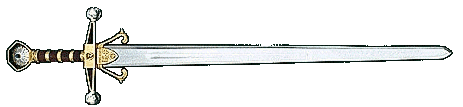
Highlander
Transcripts:
DVD Extras
|
Highlander |
|
Recorded on 1 March 2004
(from 2004 French DVD set)

HIGHLANDER: The GatheringExecutive Producer Bill Panzer |
|
Marla Ginsburg - Look at you guys, you're formidable.
David Abramowitz - Oh yes, we're very formidable, very formidable character. Marla Ginsburg - And I had to come in, you know, the solo lone female. Peter Davis - [sighs] Are we playing the female card in this? Marla Ginsburg - Yeah, we're playing the girlie card. I'm playing the 'you're the big bad guy' card. Peter Davis - I think you were very, you were very effective in representing your company's interest and still keeping things somewhat flexible to our joint input. David Abramowitz - The fact that I had to wear garlic around my neck really had no, uh... Marla Ginsburg - [slaps David's leg as the others laugh] I do remember, however, getting off the phone one night in tears and calling you. [points to Peter] And saying, "I can't do this anymore." Peter Davis - "It's over. I'm out." Marla Ginsburg - "It's over." And Peter said to me in this, you know, very sort of paternal voice, "Marla. Marla. This is the most important thing you'll ever do in your career. This is going to be a good stepping stone." Peter was the brilliant manipulator. He could get people to do more stuff in less time for less money than they had any intention of doing anything. Bill Panzer - Right. Marla Ginsburg - And I was his main pawn, and he got me back in the saddle. I was a puddle on the floor. I was a lactating puddle on the floor. I had babies all over the house. It was the middle of the night. And somehow I get off the phone with Peter. And I'm ready to do battle again. David Abramowitz - You know, I never pictured you with babies all over the house and lactating on the floor. It was rather with whips and a couple chains and things like that. Peter Davis - Don't talk about her sexual proclivities. David Abramowitz - Oh, it had nothing to do with that. Marla Ginsburg - [to Bill] This is what, this is what it was like. [to David] Well, because you-- Well, you can be a little passive aggressive. David Abramowitz - [flails speechlessly] Bill Panzer - [offscreen] Yes. [Marla laughs, gives David a kiss.] Peter Davis - But I think though that on the creative side, the fact that Bill, Marla and David were able to keep this thing together with the cross-current of interests from various parties is just a tremendous tribute. And I look at it as an outsider to the creative side of this thing. The fact that over this seven-year period that with all the cross-currents from Gaumont and the respective partners at the end of the day, each episode that came out was, as you say, a small feature as opposed to just television. Marla Ginsburg - Well, it was the goal. Bill used to always say, "We're making little movies. We're making little movies." And we did. Every one was a little movie. Peter Davis - And that attitude, everyone on that crew felt that attitude that came from the creative team that this was not episodic television. David Abramowitz - It's amazing what you can do when you're guilt-ridden and desperately need a job. Marla Ginsburg - But the truth in the matter is that after we got over the rocks, you and I [to Bill] had maybe one or two fights in all the years we've been together. Peter Davis - Oh, that is so much bullshit. Marla Ginsburg - That's not true. Peter Davis - Marla. Marla Ginsburg - We just didn't speak. Peter Davis - We fought constantly. Marla Ginsburg - Did we? Bill Panzer - We bickered. Peter Davis - Please. Bill Panzer - We bickered a little bit. Peter Davis - How selective your memory is. Marla Ginsburg - Okay. Wait. But the proof in the put-- The proof in the put? at the put? David Abramowitz - Proof of the pudding. Marla Ginsburg - Yeah, whatever. --is that, how many years later, twelve years later, we all actually have no business reason to get together and still do. David Abramowitz - Yeah, that's because we're older and we forget things. Marla Ginsburg - Is that it? No, the truth is-- Peter Davis - [offscreen] Selective memory. Marla Ginsburg - --that we spend good time together because at the end of the day, we did get through this and put out a product that we're proud of. And we got along. Peter Davis - At the end of the day, this show is the most re-watchable. People can come back and watch these episodes time and time again. David Abramowitz - Some of them. Marla Ginsburg - Yeah, there's a few dogs {??}. Peter Davis - And still have enjoyment from watching these episodes. And I think that is shown by the fact of the popularity of this show on DVD. And-- Marla Ginsburg - Peter, they bought the DVD. You don't have to sell it. Peter Davis - No, no. But it's-- there's a continuing desire of the Highlander fans to want to see this show again and again and again. Marla Ginsburg - Well, it's that cult fiction thing. Oh, and the writing was okay. Peter Davis - Just okay. David Abramowitz - And we got lucky with casting a couple of characters that really popped. Marla Ginsburg - Yeah. David Abramowitz - You know, I think that was-- I think Peter Wingfield as Methos. He popped. I think Elizabeth Gracen as Amanda popped. And they just played around in a circle, and Jim Byrnes-- Marla Ginsburg - Jim was a huge asset. David Abramowitz - --was a huge asset. Some of the main characters just really... Peter Davis - All the secondary characters, and Adrian, were very well chosen. David Abramowitz - Yeah. I mean, Adrian was great looking and moved really well. Marla Ginsburg - But Adrian also did something else that I'll never forget, which is he was incredibly generous. When we would do table reads in those early days, Adrian would-- He wasn't, you know, it wasn't about, "Give me more lines." Bill Panzer - No, he would very often say "You should say this, you know, not me, you should say it." Marla Ginsburg - No, he was very generous. Which, I'll take it even a step further back, to the pilot. I think Christopher helped really set the tone because when he did that first episode... Peter Davis - [offscreen] The one that he did for a couple thousand dollars? Marla Ginsburg - Yeah, yeah. Okay, like, okay, he was paid to be nice, okay? But he was. Peter Davis - [offscreen] I'd say so. Marla Ginsburg - We were generous with Christopher and Christopher was generous with us. And he set a tone, which was a very amicable, open kind of a gentle set, relative to some I've been on subsequently. And I think Adrian -- despite the fact that I think there was a two-year period I wasn't allowed on the set, he was so mad at me -- Adrian created a set where almost everyone was welcome. Peter Davis - [offscreen] It was three years, Marla. Marla Ginsburg - Was it three years? Yeah, but that's only because Bill and I had a good guy, bad, you know, good cop, bad cop agreement. And whenever it was his turn to be the bad cop, he just went away. So I, you know, I was the official Highlander bad cop. Peter Davis - Is that your explanation? Marla Ginsburg - The explanation was that was the year. Peter Davis - You're under oath now, Marla. Marla Ginsburg - No, no, no. That was the year Adrian wanted to direct, and I said not until the last episode. We, WE, it wasn't even I. Tell the truth. We all decided. Bill Panzer - It was a joint-- It was joint. Marla Ginsburg - But I was not the one on the set all the time with him. And you and David had to deal with him more often. So I had to deliver the news and I was banished. Bill Panzer - I think you can see why three guys and Marla is a pretty fair fight. [All four laugh.] |
Opening Credits[First ~35 seconds of original opening credits, before the cast cards.] DM - [voice-over] I am Duncan MacLeod, born four hundred years ago in the Highlands of Scotland. I am immortal and I am not alone. For centuries we have waited for the time of the gathering when the stroke of a sword and the fall of a head will release the power of the Quickening. In the end, there can be only one. |
~Bill Panzer & Marla Ginsburg~Marla Ginsburg - At the time when we first started doing Highlander, I was newly married. And my former husband used to love to watch action adventure movies, and he was sick and tired of watching all of my girly films. You know, the Woody Allena and the Barbra Streisands of it all. And he said, you have a choice tonight. You can watch this thing called Highlander or this thing called Robocop. Well, I knew I wouldn't like something called Robocop, which I later tried to option also. And I watched Highlander. And I had not realized that all that fabulous music of Queen, which I loved and did know, had come from that film. And I fell in love with it and then I was in Cannes. What year was that? 1990? Bill Panzer - {??} It was probably 1990, and I was there for the film festival. Marla Ginsburg - That's right. And a mutual friend of ours walked up and said to my boss at the time, who is this French guy, Christian Charret, who is credited in the series-- Bill Panzer - Absolutely. Marla Ginsburg - --and said, you know, sort of in this sort of dismissive-- put his fit hand over my face, kind of, 'you won't know this because it's not a chick film' sort of way. And said, "Do you think Highlander could be a series?" And in my very sort of calm, dispassionate way, I jumped in his face and said, "Oh my god, I just saw that movie. I love it. Yes, that could be a series." And Christian kind of went, "But it has Christophe Lambert." Bill Panzer - "But, uh, I mean, there's Christophe Lambert. Oui." Marla Ginsburg - So then I went back to Paris and a meeting was set in Cannes for the Film Festival. And I remember at that time, I was so pregnant and I kind of waddled on to Cyril de Rouvre's boat. Bill Panzer - Right, who at the time was partners in Gaumont Television. Marla Ginsburg - That's right, that's right. I remember waddling on to the boat and seeing this skinny little guy with glasses as thick as bottle caps standing there. And you introduced me to Christophe Lambert and all I could think of is, 'you so don't look like that guy in'-- What was the name of his Tarzan movie? Grey-- Bill Panzer - Greystoke. Marla Ginsburg - Greystoke. And here was little Christophe and you, and me the size of both of you. Bill Panzer - Well, Christophe is-- you know, it's part of movie magic, everybody looks... Marla Ginsburg - The camera loves that man. Bill Panzer - Looks taller. And he's got those killer eyes, and he's extremely charming. Marla Ginsburg - He was incredibly charming and might I say, such a gentleman when we took the pilot, but I remember meeting him in person and he just was not Tarzan. Bill Panzer - So basically, Marla-- Marla Ginsburg - Knew nothing. [laughs] Bill Panzer - --knew nothing about Highlander at all when it came time to start putting together the-- Marla Ginsburg - I didn't know the rules, that's for sure. Bill Panzer - --the package. So we had a perfect pairing. We had a television producer who never made-- Marla Ginsburg - Knew nothing about film. Bill Panzer - Who knew nothing about film and nothing about drama. And we had two film producers. Marla Ginsburg - A French company. Bill Panzer - We had a French company who had never done a TV series. We had two American producers who knew nothing about television. Marla Ginsburg - I mean, I remember the first dailies that came in, turning to Gary Goodman and going, "This looks horrible." And he said, "It's not timed or corrected." And I had no clue what he was talking about. I mean, I was an idiot. But I had a passion for this material. And that's what we really stuck to. But in those early days, putting that deal together and trying to get everybody to agree on the vision for the show and the casting for the show and dealing with all these languages and time differences... I mean, Highlander should have never happened. I mean, the syndication market was dead then. There was no room for one-hour series in syndication. A European company had never sold a series to the US. You guys had never made a series. I had never done a film series -- I mean, it's a miracle. It's a miracle that this show ever happened. But everybody who was involved, it kind of had a magic. And once we started working together and learned each other's rhythms, it was a very easy -- in many ways -- show to make because everybody was pulling for it. You know, there wasn't a lot of creative discord for the most part, except that you and David hate getting notes. |
Opening Credits[Final ~13 seconds of original opening credits, after the cast cards.] [Queen - "Princes of the Universe" I have inside me blood of kings
|
~Marla Ginsburg & David Abramowitz~David Abramowitz - Well, I'm sure we have-- You hear different stories about how we met. But I think it's kind of like-- So we don't do a Rashomon kind of-- if we do a Rashomon kind of-- I'll say how I thought we met. And then she can say how she thought we met. Marla Ginsburg - I can't remember. David Abramowitz - Well, here's what happened. I came in and interviewed for the job a number of times. And I wasn't hired, even though I knew it was the right show for me. But unfortunately, no one else did. Then you went through a number of different showrunners, and they all crashed and burned. And I went back in again, but this time you weren't there. Marla Ginsburg - [laughs] He's {going to} blame this on me. David Abramowitz - And-- No, I'm not blaming it on you. And then I heard that Christian Charret said to Gary Goodman, "We obviously can't hire a showrunner here. So YOU hire the showrunner." You know, "YOU screw it up this time." And then Gary Goodman hired me. Marla Ginsburg - Oh, I know that couldn't be true, because we would not have let him make that decision. David Abramowitz - Ah, but the last-- my last meeting was not with you. It was with him before I got hired. Marla Ginsburg - That may have been the case, darling, but I can assure you -- and I wish Bill were still in the room -- that a decision like who should be the showrunner would not have been Gary's decision. David Abramowitz - Aha. Marla Ginsburg - Here's what I do recall. David Abramowitz - Tell me. Marla Ginsburg - I do recall Elliot Webb earning his ten percent, because he called me and said-- Elliot's David's agent, and he's somebody who I've known, admired, and respected for a long time. And Elliot called me up and he said, "You're making a huge mistake. I'm telling you, this guy is right." Now, I was in France when you got hired, which is why I wasn't there. And Elliot sent me every piece of anything you had ever written. And I read it and I still didn't get it. And I said to Bill, "Take the meeting again." And Gary may have met with you, but I don't even specifically remember how exactly the conversations went. But what I do know is Bill and I are such control freaks that there is no way that anybody else hired you. David Abramowitz - But I only met with Bill after the fact. I met with Gary and then I went away for the weekend. And I said-- 'cause I remember, it was my tenth anniversary. And I went away for the weekend and to Montana. And I got this FedEx at this Bed and Breakfast in Montana saying, "You got the job. Here are the scripts. We need them in two days." Marla Ginsburg - "Go to work." Well, listen, I-- Whoever hired you did a good thing. David Abramowitz - Well, it was a blessing for me too, Marla. Marla Ginsburg - Yeah, I know. I've been to the house. David Abramowitz - [fake laughs] Ar, Ar, Ar, Ar, Ar, Ar. When I got there, you know, I think that-- First of all, let me say it was set up for me to succeed because the show was desperate. They were behind, you know, they needed material. So all I had to do was make it reasonably credible and I would come off like a savior. And because of my basic personality, I was too guilt-ridden, I felt too terrible that I wasn't going to please everybody. Marla Ginsburg - [laughs] That is so true. David Abramowitz - Right? So initially, I had to come in and please everybody, which is why I went through two secretaries because I would stay till one or two o'clock in the morning rewriting things. Marla Ginsburg - Yeah, okay. You went through secretaries. I went through a husband, so don't complain, okay? David Abramowitz - Yeah, well, I know. Yes, that's true. And then, and then, so people left and the initial material, the material that I had to work with, was problematic. Marla Ginsburg - It was bad. David Abramowitz - It was bad. But mostly because I think it went through so many filters that it was unfocused and it lost-- it lost whatever the vision was. Everyone thought they knew how to fix it, and probably any one of them on their own could have fixed it alone, but when it became an amalgam and it tried to be everything to everybody in any given moment, it just got too dispersed and it lost the focus of the material. So I came in on "Mountain Men", which it was, I think that was episode six or seven. I did a little polish on that and then the scripts-- It was already too late to come up with new stories. So that's why we had "Deadly Medicine" and this, and there was some script about someone scalping people, which is, whoah, which wasn't exactly my idea of what the show would have been. And then, I got this script, thank God, by a guy named David Tynan, who was a writer-- Marla Ginsburg - What was that one called? "Sea Witch"? David Abramowitz - "Sea Witch." That was actually 75, 60, 70% there, where it was intelligible and you got it, which bought me a week to get the rest of the material together. Because I didn't have to start from scratch. I mean, there were times when we were getting in scripts that were so bad, that needed to be shot, which-- Marla Ginsburg - That's because in those early days, Christian Charret made me hire French writers, remember? David Abramowitz - Well, no, for the first two years, we had French writers. Marla Ginsburg - And so we had French writers, and no showrunner for a while. David Abramowitz - Right, and the scripts, and they were just-- Marla Ginsburg - All over the place. David Abramowitz - They were just all over the place, and they were unintelligible, and the stories weren't structured and bad, and it was amazing, because the guys who were on before me, I mean, they were real writers, you know? I mean, they had shows, they had lots of credits, and they couldn't do it. Marla Ginsburg - But they had a different ego, David. The people who were there before you, it was all about them. And with you, you really were eager to please, and you made it about the show. And I think that's why it worked, because the truth is that Bill and Peter and I didn't know what we were doing, and we were operating on instinct, which meant that we were making mistakes. So we needed a kind of sneaky leader. David Abramowitz - Sneaky. That was me. Marla Ginsburg - A sneaky leader. David Abramowitz - Sneaky leader. Marla Ginsburg - We needed a sneaky leader who could say, "Oh, my God, this room is filled with ego and arrogance. How can I get these stubborn people to do the right thing?" And you did it. David Abramowitz - Well, I just got-- That's because I really needed the job. I thought coming in, it would be thirteen weeks and out, and I'd be fired, but at least I'd get paid for thirteen weeks, because I wasn't working the network, and I didn't even know really anything about syndication. I just wanted to work, and it was just-- I was just so happy to have a job. Then, I fell in love with Highlander, and with the possibilities and storytelling, which was different than anything else I'd ever done. Marla Ginsburg - Well, it resonated to your personal background. David Abramowitz - Right. Marla Ginsburg - As David's voice became the voice of Highlander, and he and Bill formed a partnership, my job really was to put together a great team, hire the best people that I knew how, make all the partners happy, and then at some magical moment, it was time for me to let go. And I think that happened pretty much in season two, or three? David Abramowitz - Season two. Marla Ginsburg - Season two. Where I literally just let go. And to be honest, I haven't seen every episode of Highlander, because it was really a painful decision. But I knew at some point that if I didn't step back, there wasn't room. Somebody had to step back, and it certainly wasn't going to be Bill. And I had Nikita coming up. So when the chance for me to go off and do La Femme Nikita came up, and, you know, I was the only one in the group who had, like, a day job. You know, I had this job for this French company. So it was the right moment and the right time. It was very painful for me. At the time it occurred, I don't think Bill or David actually really acknowledged. I mean, I felt that I had made contributions that weren't being acknowledged, and I felt it was time for me to go away like a lady, and let them do their thing. And I did. David Abramowitz - For me, especially in the first year and a half, it was just about surviving, and making sure the show didn't shut down. We had a very small staff. When I came into the show, you know, I was used to writing on writing staffs where they were six writers, seven writers. When I went into Highlander, I got there, there was me and somebody else. Marla Ginsburg - Two guys, a girl and a pizza. That's really it. David Abramowitz - But there wasn't even a girl. Marla Ginsburg - We couldn't even order the pizza. David Abramowitz - I didn't even have the girl. No, it was just me and someone else. And half the scripts had to be written by French people, whose English was not their first language. And didn't really understand American story structure. So it was just this, 'How do I get through this? And how do I survive?' And it wasn't that I didn't agree with Marla, though sometimes I didn't agree with Marla, or didn't agree with the French and Germans. There just didn't seem to be enough hours in the day. I was just looking to get something that worked. And as long as it worked, I just needed to get through it because there was always a next script. You know what? You know why I think-- One of the reasons I think it worked is because the concept of the show, in some ways, changed after, in the second year. And I think it went from being, 'How can we find who's the next bad guy,' to 'Okay, an Immortal is a nihilist.' And 'How do you do an episode about an immortal as a nihilist?' Rather than 'This guy killed MacLeod's best friend when he was nine years old' and that kind of stuff. Marla Ginsburg - We started to really shape-- Bill went away-- Bill and I -- and I don't know why you didn't come with us-- David Abramowitz - You didn't invite me. Marla Ginsburg - That's probably why. Bill and I went to Palm Springs. David Abramowitz - Which I was really, I was really stunned that they would come back and say-- Marla Ginsburg - Here's season two. David Abramowitz - Here's season two. Marla Ginsburg - Well, whatever. David Abramowitz - But they brought the Watchers. Marla Ginsburg - We did bring the Watchers. David Abramowitz - But-- Which I got immediately. Marla Ginsburg - Yeah, you did. David Abramowitz - Brought in the whole {Leviathan}. Marla Ginsburg - You got the whole Watcher thing right away. David Abramowitz - Yeah, yeah, yeah, yeah, yeah. Marla Ginsburg - No, Bill and I went to Palm Springs and we came up with, "Okay, what are we going to do to freshen this? And what can we," um-- And probably the reason that we didn't invite you? It was enough arguing with just he and I. And I think what we wanted to do is have one voice. I think we wanted to come to you with one voice and say, "Look, this is how we see it. Now, what do you think?" It may not have been the right choice, but that's what we did. David Abramowitz - It was never, it was never-- First, it was never, "This is how we see it. What do you think?" It was always, "This is how we see it. Do it." But yeah. I think everybody on this show thought they were doing something special. I know everybody works on lots of things, but... Marla Ginsburg - This was special. David Abramowitz - This was special, you know? You looked at it and you thought, "You don't see that on other television shows." Marla Ginsburg - Listen, to this day, I travel all over the world, and there isn't a country or hotel room that I go into anywhere in the world where I either don't see this on television, I meet a fan of the show... And really, I mean, all kidding aside -- because it wasn't all THAT contentious, I don't think -- the fact of the matter is whatever happened needed to happen, because, you know, history works sequentially. And the sequence of events that led us through all of these episodes were necessary. And there were a lot of different things to have balanced. And I can tell you now, twelve years down the road, where I do know something about making TV shows finally, I'll never have as much fun as I did on this show. I hope I get to do something that resonates this much again. And the fact of the matter is the relationships of the people who did this show today compose part of my most intimate circle. So despite the fact that we-- David Abramowitz - And we stayed talking all these years. Marla Ginsburg - We stayed talking, we eat, we celebrate. David Abramowitz - Even, though, even though -- right. Absolutely. Marla Ginsburg - So, you know, it was necessary. It was a necessary process, and the success of the show, I think, rests firmly on our combined, insecure, passionate, opinionated shoulders. David Abramowitz - Yeah, you know, the other thing I find really interesting is -- about when I would travel is -- the people who would actually be fans of the show. You know, I would-- You'd go somewhere and you'd be in an emergency room and there'd be a doctor. And the doctor, who was from South Africa, would say, "God, you know, I watched the show and I love the show." Marla Ginsburg - It's amazing. David Abramowitz - And then you'd meet someone who was a PhD candidate in philosophy. You know, there was once, there was this rabbi who wrote a PhD thesis on a Highlander episode. Marla Ginsburg - I had a woman who managed one of the PBS stations tell me that Highlander was the most popular show among the PBS operators. I was in Cabo with my parents and there was, like, you know, 'Mildred from Skokie' or something. And she had one of the Highlander bags, you know. And my mother's like, "Marla, this woman wants to meet you. She's a Highlander fan." And I'm thinking there's going to be some girl. And there was like, you know, someone my mother could play canasta with, you know, who was a fan of the show. David Abramowitz - It was just-- It's just amazing to me that the people, the people who really like the show -- because it was, it was really, you know, it's not a terribly accessible show. I was thinking this weekend -- because I was at a small convention or a workshop or whatever you call it -- you know, about the Watchers. The Watchers was a great idea, but it made the show so much more confusing for casual viewers, because here was this whole other group of people who didn't really do anything, except observed what the other people were doing. And how would a casual viewer come into this and say, "Who are these guys?" you know -- and NOT say, "Who are these guys? What are they doing there?" Marla Ginsburg - But that's why it's cult fiction and that's why it's classic cult. David Abramowitz - Yep. Yep. |
~Marla Ginsburg~When you watch an episode of Highlander, what you don't see and you shouldn't see is that it was a business. It had to be financed. And it was financed and put together in a very unique way. We had German partners, French partners, Canadian partners, Japanese partners, Italian partners, and Bill and Peter. And nobody had ever done what we were doing, including ourselves. My favorite story about what a mess it was in the beginning -- in addition to the fact that we went through showrunners like toilet paper until we found David -- was that when we sent the first dailies out on Highlander, I got notes back from the Japanese saying that they had a problem with the hardware. And I just assumed that we were having a misunderstanding and that they were using a word that meant something else, because who would give a note about hardware. But indeed they had a problem with the door knobs. And ultimately they dropped out. You know, they really wanted a rock star in every episode. And it was a lot like, you know, I remember the early days of Entertainment Tonight, a show I worked on where we couldn't book anybody. Nobody wanted to do it. Highlander was the same thing. In the beginning, no one wanted to do the show. And we had a really hard time booking rock stars because they were either in rehab or the studio or unavailable or whatever. And that's what was in it for the Japanese. They wanted that music element. The Germans wanted sort of the fantasy and the gothic aspect. The French wanted something that was very contemporary and had a resonance for their audience on a weekend. The Americans wanted something that would work in prime access. And Bill and Peter wanted something that was a little movie every single week. However, after we went through a bunch of showrunners, David Abramowitz came on board. And that made all the difference in the world. As we got to know David, we realized the only really wrong thing we had done was just not hire him from the beginning. And he stayed with the show throughout, and I think really was the guiding force. He and Bill. I think the credit I'll take is for putting it together in the beginning and putting up with everybody. I was the person in the middle that everybody called with their notes and I had to give those notes. And I was acutely aware of the fact that I knew nothing. So I was having to rely on instinct and gut. Two hundred and fifty episodes or whatever later of trauma that I've now produced, I at least have some experience I can lean on. But in those days, honest to God, it was gut, sweat, and an incredible desire to succeed with this property. When we first started doing Highlander and I was selling it around the globe, I told buyers that I thought Highlander was the next Star Trek. I felt it had the same cult qualities as Star Trek, classic cult fiction. I'm not surprised that twelve years later there are still fan clubs, there are still people who want to see more, and that there are people for whom this show resonates. Because it was a smart show. And David infused it with a lot of different levels. You know, it certainly ain't Shakespeare. But similarly, Highlander is a show that a ten-year-old can watch, a thirty-year-old can watch, a seventy-year-old can watch, and they're going to see a different show. And you know, that's really great drama. For me personally, the nicest thing about the series moving to France was I could actually work in my own time zone. That aside, Bill was petrified and the Americans were out of their minds. Everybody thought we were crazy to move the show to Paris. Denis Leroy, who was our line producer at that time, handled it so perfectly, so impeccably. Truth be told, I think we got some of our best shows out of France. But everybody was freaked out and frightened because, you know, if you're the American distributor or you're Bill, you're walking onto a set where everybody's, you know, speaking a language you don't get, and in our infinite paranoia, assume they're discussing things that you want to know about... or YOU, you know. And you're not a part of it. The fact of the matter is when Bill got there, I think he was very pleasantly surprised by the fact that most of our crew was bilingual; where people weren't bilingual, those services were provided. The French crews did a great job. And we brought some people with us. I mean, our DP worked in Canada and then brought us over to Europe. I think the European episodes were a pleasure. They certainly were a pleasure for me. They weren't without their complications. I mean, I remember the look on the faces of everybody from the American side, the first day we had lunch on the set. Because in France, there's no wagon with burritos. It's, you know, sur la table. And that-- 'feet under the table'. So people literally sit down to tablecloths and bottles of wine and a three-course meal. And I shouldn't be saying this in front of any crew in America. But that's lunch. We did eventually take the wine away, however, because we noticed the productivity really went down in the afternoon. But, you know, it was a completely different experience, and it was a much different set. But it ran on time. We were never over budget. We were never, you know, we delivered. And I think some of the French episodes were among the best. |
~Peter S. Davis~The thing about Highlander, when you look back on what you've accomplished in your career as a producer, and you can point to a product that has changed people's lives, and at least you know you've accomplished something that's been meaningful to a vast group of people. And very few shows you can say that about. This has influenced people's lives. I was at a dinner party and I met this young writer. And he made the statement that Highlander changed his life and he gave a whole long explanation about how it happened. But the fact that someone can say that the show changed his life and influenced him in such a, you know, a deep-rooted way. It gives you a sense of-- that you have actually, in our crazy world that we live in in this entertainment world, that you have accomplished something that has a real meaning to a lot of people. |
~David Abramowitz~Okay, we're on. There was a lot about Highlander that inspired me. The actors, the sword fighting, the action, but mostly it was the opportunity to play on such a broad canvas. The ability to do flashbacks. And you know, Steve Geaghan, who was, I've said this before, who was the production designer, art director kind of, when he said to me, "What is Highlander?" And we talked about it for a long time. He said, "I get it. It's a Talmudic discussion with ass kicking." And that, I thought, was the best summation of what Highlander was. The ability to have a Talmudic discussion on television was really-- was just such a great opportunity because it was such fun. There were things to write about. You could write, you know, more than 'Which way did the bad guy go? Why is the bad guy doing this?' It was-- You could have two Immortals or two characters having totally different opinions on a subject, and both characters can be consistent and be right in their own minds. You know, like what's the difference between honor and vanity? Like how long do you have to keep a promise if you're immortal? Those kinds of questions don't have answers. Is it all right to kill twenty today to say five hundred tomorrow? You know, there isn't a right or wrong for those questions. And if you can design an episode around things like that, it's just a great intellectual game. And actually just asking those questions and having the ability to talk about those things elevates you from the mundane. And I think makes you a better person. Well, what Highlander's meant to me. Highlander was the first show I was a showrunner on. It was the first time where I carried the burden of responsibility. Where what I thought really mattered and what I thought-- I was the final typewriter that said, "Okay, we'll have him say that." And he actually said that. And it was just an amazing thing. But Highlander fit me so well personally. And some of the working experiences, the people I worked, with are still in my life, I still see and I still talk to. I would go back into it in a minute. In fact, I am. I just wrote a Highlander miniseries, and I hope it goes and I hope we do three or four of those a year because the material is wonderful. It's just-- and not because I write it, but because it has such a density of character and such a density of emotion. You know, can you imagine? What Highlander has that other series don't have is the ability to show character development over centuries. So say you have a woman who's a bitch today. And you need to look at her and you say, "Why is this woman a bitch?? And then you learn that two hundred years ago, four hundred years ago, she was betrayed by a lover and burned at the stake because of it. You know, she'd be pretty pissed at men, you know, forever. And it allowed the audience to see that. So it allowed you a greater glimpse into the humanity of the character. And that's always fun to write and it always makes it clearer for the writer. And it just gave you enormous opportunities. You know, you can write about Attila the Hun. How many people get to write about Attila the Hun in a modern-day episode? You know, you can write about being a-- what it's like to be a Spartan general and stand on the side of a cliff and look at a child who's dying because you've commanded that he should die because he's got a club foot. How does that make you feel? What happens to that character later on when he realizes how-- that he was stupid or that the times interrupted him? You can look at morality over time. You can look at values over time. And you can make great commentaries on how you live today. You know, it just-- it just allows you to have a great voice and it makes it easy. But as I look back, the best thing was some of the people, you know, working with honorable, mostly kind-- a lot of the writers were great. James Thorpe, Dave Tynan, Gillian Horvath. You know, I learned a great deal from them. And I would always hire, try to hire writers who didn't do what I did, but actually made the work better, and I think most of them did. Under great time pressures and enormous problems in terms of not enough money, but everybody involved in the show was trying to do the best show possible. And another person I have to commend is Adrian. Without Adrian, there would be no show. He was really the rock of the show. Adrian was very generous with other actors. He allowed them, sometimes the better lines -- and Methos. Peter just said to me the other day, "I had the best lines in the show." And he did because it was consistent in his character. Many actors who were stars of shows wouldn't allow that to happen. But for Adrian, as long as what we wrote was consistent with who we thought the character was, we could take him anywhere. And that's a great-- That give you great opportunity. And makes doing the show a great privilege. |
~Marla Ginsburg~Highlander was a very personal time for me because-- by virtue of the fact that I was on the other side of the planet, it had, you know, our home became like an office because I'd be up all night, during the time we did Highlander. I mean, Highlander got picked up the day I was in the hospital and gave birth to my daughter. I will always know how many years ago we made the first episode of Highlander because she was, she's now twelve. So, you know, it dates itself very personally with me. You know, I moved to Europe. Highlander came along very quickly and Highlander was a definite part of my life and not just my professional life. It's been a part of my personal life and my kids' life, you know. I'm very lucky now because I get to make a lot of one-hour drama. And I've had some great experiences and been a part of a couple of shows that I'm quite proud of, this being first and foremost. So it launched my career in one-hour drama. It gave us a wonderful life. And it marks the most important period of both my personal and professional life. It marks the beginning of my family and the beginning of my professional family. So, it was an incredible stepping stone. The night that I called Peter and said, "I can't do this. I feel like Sisyphus." And he said to me, "Oh, yes, you can. And this is the most important thing you'll ever do." He was right. It changed my life. It allowed me to play on a game board that I never thought I'd get to be on. And I'll tell you, as a woman, and I don't typically play that card. I mean, I tease the guys about it, but I don't play the girl card very often. But in the world of action, adventure, television, there aren't too many women who get to produce sword fights and car crashes and do all that neat stuff. And I have very much enjoyed playing in this sort of rough-and-tumble kind of drama as opposed to kind of, you know, heart-wrenching girly stuff. And I've had a great time and I've learned a lot. I will tease Bill and David and Peter and everybody else involved in the show, but I grew up on this show as a human being. So, it's been a sort of all-pervasive experience for me. |
~Peter Davis~I think, as I indicated earlier, it's the fact that we have been able to create an intellectual property that has been intellectually provocative to an array of people worldwide and has sustained that interest over a twenty-year period, means that we have created something and leave something of incredible substance. We have changed people's lives. We have given joy and pleasure to millions of people worldwide. And to look back on your career as a producer, and if you've done, you know, eighteen, twenty features, and you've done, you know, a hundred and forty hours of television, to be able to say that is very meaningful to me. And I love the fact that you, anywhere that you go in the world, when the inevitable question is, "Well, what have you produced?" -- because that is the inevitable question, once they know you're in the film business -- and when you murmur "Highlander", inevitably you get such a strong reaction from someone in the group who says, "I love that show. That show is fabulous." You get it all the time. When you get it on a continuing basis, it has to mean something. You're not-- Someone's not being kind to you at a dinner party by stroking you. It has to mean something. And by meeting something to them, it's very meaningful to me. |
BACK to Transcripts Page
| Home |
| Personal |
Tess |
TV shows |
Lord of the Rings |
Pern |
| Actors |
Buffy |
Highlander |
Transcripts |
Fanfiction Links |
| Check out my Sitemap for more 'updates' info. | Last updated: July 17, 2026 |