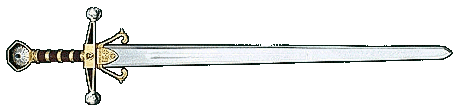
Highlander
Transcripts:
DVD Extras
|
Highlander |
|
(from The Best of Highlander: Deluxe Collector's Edition 2002)

|
Bill Panzer (Executive Producer): Hi, I'm Bill Panzer, one of the executive producers, with Peter Davis, of the Highlander movies and television show.
Clip from Season 4-6 Opening Credits:
There was only so much you could do within the one film. And gradually, over a hundred and nineteen hours of Highlander, we managed to develop a much more sophisticated, complex series of -- as David Abramowitz likes to call them -- sort of Talmudic Morality plays.
Clip from "Band of Brothers":
If I were to say what I was on the show, is I think I'm the show's mother, and Bill Panzer is the show's father.
The executive producer is like the beginning and the end. You make sure that the story and the script is as good as you can get it. You've got your principal actors already cast. You rely on the director and the producer to cast the guest stars. Unless they're going to be like a Roger Daltrey or other names that we ended up casting. And then you let them go about their business, do the work, and just make sure that when you're back in the editing room, that you're representing the interests of your creative and financial partners, and that you're being as honest and true to the Highlander legend as you can be. David Abramowitz: I love the flashbacks on Highlander. They are what's different about the show. They're the thing that enabled us to create worlds and characters that we don't see today, and can't see today, and with the power of retrospection that you can look back and say, I know how it came out, so wouldn't be interesting if... And what amazed me often was some of the production values that they were able to generate, on a television budget, of great battle scenes and great castles and dress balls and things like that.
One of those, okay, let's show the French -- who don't think, and the Europeans in general, don't think that we can do the Battle of Waterloo here in Canada -- let's show them. Director wanted cannons and he wanted every piece of hardware we could possibly find. It was a great scene.
The Battle of Waterloo, it's a defining moment for Duncan MacLeod because it's when he met Darius. I love that flashback. It was a major moment for MacLeod, and it was the first time for him when he believed that the way of the warrior may not be the only way for him, because that's what he had been up until that point. David Abramowitz: Darius turned out to be a wonderful character; strong, foreboding presence. He was one of the people who sacked Rome with the Visigoths.
We had always felt that MacLeod, Duncan MacLeod, needed somebody to talk to who was Immortal, who was significantly older than he was, and with whom he had had some kind of epiphany-like experience in the past.
What was interesting about him was that he was written as physically ugly, as a character who looked more like the hunchback of Notre Dame, but had a great soul and a wonderful heart.
When we cast Werner's stalker, we were ecstatic because it was like this was the guy. He had a kind of a tranquility, but yet you believe that he could have been a great and brutal warrior, which he was for many, many years before he chose the path of peace on Holy Ground.
So Darius turned out to be attractive and turned out to be a hero and turned out to be a wonderful character. Unfortunately and tragically, Werner became ill and he died. And it was a great loss for the acting community.
Clip from "Deliverance":
And a tremendous loss for the show, because he was a wonderful character and he could never be replaced. Bill Panzer: No matter how organized everything is and how diligent, energetic, professional, the producer, the crew, the cast are, sometimes you run into problems where the big electrician in the sky is turning the light out and you don't get a chance to finish everything. In that case, which happens from time to time in both movies and television, you call on a second-unit director.
One of the things that I have done on this show was to shoot second unit. And most of the time when we do that, it's a lot of fun because you're not burdened by the size of a crew that you have when you're shooting first unit or principal photography. So we have these little guerilla groups that go out and you're driving around the van and you go to a location that you need to get a shot and you jump out with the camera and you do the shot and you throw the camera in the van and you take off and head for the next location. The first unit really doesn't have the time to do this stuff. And secondly, if they did have to do it, it'd be an enormous burden because you're moving sixty, eventy people around. And this way you just run out there and you grab these shots and you get production value that helps the show and you help the directors out and it's always kind of a lot of fund to just to shoot anyway.
And he went out on numerous occasions and both filled holes and would shoot things that we thought of weeks after we were shooting, you know, "wouldn't it be nice if" and Don would say, "Hey, I can do this." And would go out and come to that and a lot of times it made a tremendous difference in the show.
What I remember most about it was a specific scene in this -- was it a sulfur mine, I think, in Vancouver? -- that was shot and Don Paonessa directed the second unit and shot it. And I remember getting the tape and commenting on that particular shot because I thought it was very cool looking.
And when we were taking our first general scouting trip, when we first got there, they're driving around and we look across the harbor and there are these two enormous, they must be eighty feet, a hundred feet high, mounds, yellow mounds. And we said, "What are these? We've got to use them."
When I saw the mountain of sulfur they were fighting on, my first impression was, "Thank God I wasn't choreographing that show."
Grayson is fourteen hundred years older than Mac and is that much more experienced and is a very formidable opponent. And Mac is on the run for the first half of it.
They had fought their way through the industrial facility and then up this conveyor belt and then down onto the mountain. And it was a legitimate mountain of sulfur.
And then of course once they get to sulfur mountain, Mac is able to pull himself together and there becomes a reversal in typical hero fashion and he is able to ultimately triumph.
It was one of our more dangerous sword fights for the actors. Both Adrian and Grayson both look like they're exhausted, and they were exhausted, and they did everything themselves -- the falls, the stuff that was-- I mean, they were both bruised, battered, lightly bleeding and very happy to get away from this fantastic-looking location after shooting all night. It was a great Quickening. I mean they had charged, loaded this gantry tower. When I watched the first take, which was The Take, the master ran for about two and a half minutes. And it was a movie. You could not-- We could not have done anything and never did anything any grander in terms of pyrotechnics than we did that night. F. Braun McAsh: A flamberge blade, for those of you who don't recognize the term, is a blade where the edge is wavy like this. [moves his hand back and forth as he lowers it] There have been a lot of theories kicked around as to why the blade is designed in this fashion. It actually provides a very interesting cutting surface, because instead of lacerating, it macerates. It sort of chews into the body. And as a consequence, the upper and lower section of the wound doesn't match anymore. So it's a very difficult thing to heal or try to stitch back together. I have seen flamberge blades on what are called great swords. The huge two-handed great swords that the German Landsknecht or the Italian condottieri used. But I have never seen a flamberge blade on a small sword like that or a true medieval broadsword. I know we've just used a few terms that some people might not be familiar with. So, let's just explain a few of the things for future reference. [holds up a dagger] Obviously not a sword, but it's got all the parts to it. The crosshilt is referred to as a quillon and then of course the grip and the pommel. And this is a double-edged blade. Obviously not all swords have double-edged blades and not all swords have straight blades. [sets dagger asie, takes rapier from De Longis] We have a Pappenheimer-style rapier. This is the transition between a swept hilt which has a hilt full of bars such as this. [De Longis shows off a swept hilt.] And when they started using the point more than the edge, they had to start filling it in because obviously you can thrust through that. And eventually it became a cup hilt which was just a dish.
Behind-the-Scenes clip from "Band of Brothers":
One of the things about Grayson's sword is that everything about the hilt and the grip and the pommel said medieval period -- you know, 1200s, 1300s, 1400s -- and then this blade which was completely out of character to the weapon. But I guess as an Immortal, you would not necessarily even have a single sword retain the blade if you found a blade-- a different design cut more effectively or even the psychological effect of it.
A nice reflection on the character of Grayson because it is flamboyant. It is also very intimidating, because as you've said, you know, it's designed to inflict seriously nasty wounds. And just, you know, seeing an opponent who was carrying such a weapon is going to give you pause and make you hesitate. And that's precisely the sort of advantage that you're looking for.
Clip from "Band of Brothers":
Stan Kirsch (Actor): There was a practical joke that got pulled on me during "Band of Brothers".
They were doing a scene where MacLeod decides he's going to go off and get focused and build his strength to fight the bad guy in the show.
I'm training Adrian and I'm spinning the log and he's jumping over the log and we have all this dialogue back and forth between us. We were shooting on a hill and I was on the top of the hill and when they were doing the portion on me, the whole crew is behind Adrian and the camera. You know, it's like sixty people there. I'm going through the scene. I'm saying the lines and all of a sudden--
Behind-the-Scenes clip from "Band of Brothers":
--the whole crew, I see everybody look up and go: [gasps].
Behind-the-Scenes clip from "Band of Brothers":
I just imagine-- the only thing I can imagine was that a tree was coming down. So I duck and I cover myself. I slowly sort of inch around and look up and I see this Sasquatch like lion type of thing going, "Raaaa!"
Behind-the-Scenes clip from "Band of Brothers":
Scream and run out of frame and everybody starts laughing and it was a crew member that Barry Rosen had. Barry Rosen had -- he was a producer at the time -- rented the outfit and put a crew member in it to play this practical joke on me.
One of the grips, I think, dressed in a bear outfit and scared the poop out of Stan, because he thought this bear was actually coming to attack him. Bill Panzer: When we started Highlander, we had a great concern, Peter and I, that we have a television series that reflected both the spirit and the fun, the sense of adventure, the legend, the myth of the Highlander films. And we felt that we made a very good job of first making a transition from a film to a TV series and then building on the legend that asked and answered questions that could only be asked and answered by people whose life spans were far greater than ours. And at our most interesting, I thought, was when there were questions that were asked and we couldn't answer them. Just as in real life, sometimes you don't have the answer to the question because it's not all black and white. It's usually gray.
It just occurred. It happened. We figured it out. I was blessed with some very good writers and some very inventive people and we became lucky. |
|
Bill Panzer (Executive Producer): The character of Amanda was kind of different from most of the Immortals that we've had around Duncan MacLeod. We always thought it would be fun for people to find out where she came from, where she had her first death, what kind of a life she had until she ended up being a jewel thief, international courtesan, sometimes lover of Duncan MacLeod.
I loved "Legacy". I loved "Legacy", because we wanted to show where Amanda came from. Amanda was such a wonderful character that we thought we needed to create a really good backstory. I think Amanda, as a character, was a character who was starving to death as a young woman, who had to steal food in which to live. And I think that kind of person, as they grow older, very often never has enough things. So things became incredibly important to her, and having things, and making sure there was always enough. MacLeod was a character of honor, of guilt. He was born and bred from his childhood to assume the responsibility for the clan, which is why he went into the world saving all of these people, because he believed it was his responsibility, and that not to do it would make him less of a human being in his own eyes. In Amanda, he sees lightness, he sees gaiety, he sees irresponsibility, and he sees incredible sex. And I think they both probably were incredibly good at it.
Clip from "Legacy":
Ken Gord (Producer): Interestingly enough, I always felt that the casting of Immortals was the least difficult, and that's because there was some kind of intangible that an actor had in the casting room, that they either sort of had this sort of Immortal quality, or they didn't. And to me, it was really, really obvious. I'm not even sure what the quality is, just that an Immortal had to have a little bit of larger than life, a little bit of sort of timelessness about him. But he could be any age, or any sex, or any look, it was just a quality. The casting of Rebecca was a challenge in "Legacy", because she had to be timeless. She was thousands of years old. She had to be Amanda's mentor, which means she had to be incredibly wise and smart, and matronly. But at the same time, she could not be dowdy or boring. She had to be hopefully sexy and entertaining. I was very happy with the Nadia Cameron, because I thought she fulfilled all the aspects of the role that had to be captured. She had that sort of Immortal quality, which, again, is an intangible. But I know it's there, and the viewers know it's there.
The only thing we did wrong in that episode was kill Rebecca, her teacher. And what was supposed to be just a springboard became a wonderful character. I love the actress. And I thought that she was a-- would have been a wonderful addition to the show. And she was in a couple episodes in flashbacks, but I didn't know. I didn't know they would be magic. I didn't know she would show such strength and courage and wisdom and play perfectly against Elizabeth. It remains one of my favorites, because I love the flashback. I really like the villain, who doesn't say much but is a remarkable presence. And I think it got to show another side of Amanda. Of an Amanda who was at some time in her life more than just self-interested. F. Braun McAsh (Sword Master): We used several systems of parrying swords on Highlander. The first one, which is most commonly used in theaters, the edge-on-edge parry. [Anthony De Longis brings his katana down in an overhead strike at F. Braun. F. Braun parries with the front edge of his katana.] Quite static. Historically, they would sometimes use the back edge, because it wouldn't compromise the cutting edge of the blade... [Anthony De Longis brings his katana down in an overhead strike at F. Braun. F. Braun parries with the back edge of his katana.] But it looks a little strange to the untrained eye. We also used what are called ceding parries that allow the opponent to go through to set them up for the next blow. [Anthony De Longis brings his katana down in an overhead strike at F. Braun. F. Braun parries while movng to the side away from De Longis's blade, then swings his own katana around to rest at De Longis's neck.] And several different types of slapping parries. The first is {Sukoman} that involves flat of the sword against the flat of the sword. [As Anthony De Longis swings his blade down past F. Braun's right shoulder, F. Braun slaps it aside with the flat of his own blade, then brings his katana around to rest against De Longis's neck.] And then the back-edge parry. [As Anthony De Longis swings his blade down toward F. Braun's right shoulder, F. Braun slaps it away with the back edge of his own blade, then brings his katana right back in to rest against De Longis's neck.] You'll notice that in some of these we're displacing the body to the side, just for added protection, not only for the visual aspect. If you are ever mistiming one of these things, the sword can come in on you, and it's best not to be there at all. [F. Braun steps to the side as De Longis swings his blade down and pushed F. Braun's katana down.]
Clip from "Legacy":
F. Braun McAsh (Sword Master): It's not really a fight per se. It's a training scene where Rebecca is training Amanda, so automatically the emotional tone of the fight is not-- there's nothing intrinsically dangerous or deadly to it, but it is nice to see the joy and the enthusiasm that the two women had for doing this, and very rarely do you have women fighting in Highlander until, well, almost season six was the only time we had a great number of women fighting, and rarely if ever fighting another woman. So it was an interesting little piece.
Well, babes with blades always works for me. And keeping with what Braun said, I enjoy the scene very much because you realized very early that, oh, they're not fighting in earnest, but yet they are testing each other. They are trying to push each other, and Amanda is able to show how much she's learned. The joy that they both feel at the end and the confidence that she feels sets up the next scene, which is where she says, "I've taught you all I can, and it's now time for you to go out on your own." So the emotional change is from one extreme to the other, and that's what good choreography can accomplish. It can take the emotions of the audience in one direction so that the story can then quickly turn back on itself and be that much more effective.
In "Legacy", there was a multi-level fight at the very end when MacLeod and Luther are battling it out. As soon as you put people on two different levels, you have automatically restricted your targets. And even the type of blows that you can do are relatively restricted now, too. So that, plus just the problem of clambering around up and down on ANYTHING, let alone something like hay bales, which have a tendency to not--
[chuckling] Collapse.
--not be the most secure underpinning for feet, which is why in the "Legacy" fight, an awful lot of the fight takes place where they just sort of stand rooted to the spot and flail at each other, because it would be extremely difficult to try and do anything when you're stepping up three feet at a time. It's not even as easy as stair steps, where you're only really talking about six inches or so.
It is very difficult to continue to tell the story and to maintain safety when you are struggling for footing. We'll have more on that later. But in that sort of situation, it's always like walking through a minefield because, particularly in old ruins and stuff, they haven't gone out and smoothed the surface. So there's a rock here that's covered with grass or moss or there's a hole or something and you're in the midst of a fight and it's never -- even though in film you get the advantage of being able to take it again if something goes wrong, providing you haven't poked each other in too-important a spot -- it's never the same, it's never-- It's not an exact science, it's a dialogue in movement and energy between you and your partner, and pretty much anything can happen.
The swordfight in "Legacy" and the Quickening was one of those ball busters, but then they all are because it takes about a day to do a swordfight and the Quickening at the end.
Sometimes, as we all know, we start to run out of time, and this was the first time in "Legacy" that we had an issue where the swordfight started during the day and it gradually got darker until the end of it and the Quickening at night. And since the whole event takes, I don't know, two, three minutes on film, it's a little bit of a stretch of the imagination, so we had to work some magic in post-production, and Don Paonessa came up with the idea of "let's bring in a different sky." Let's have the sky turn from clear to stormy, from stormy to dark, let's throw in a little of this and a little bit of that, and it'll make the transition appear far more pleasing and believable.
Well, fortunately, when they shot Adrian, the MacLeod character, beheading Luther, the bad guy, it happened that he was shot towards the sky and the sky was pretty burned out. So because the sky was burned out, we were able to easily pull a mat so we could key a new sky in behind him. And in doing so, what we did was we created a sky that had clouds in it, and as the clouds rolled in, they got darker and darker, and we turned day into tonight, as it were.
All the directors of Highlander knew that even if they didn't deliver exactly what they were supposed to in terms of footage, that the incredible post-production department would either fix it or make it better. All the directors had incredible faith in post-production. Don Paonessa: One of the problems that we've dealt with when we were and when we have done shows that come out of France is that a lot of the actors that are hired are French actors that-- They do a hell of a good job speaking English, a lot better than I do speaking French, but at the end of the day, they're not that easy to understand, so what we end up having to do sometimes is we have to re-voice the characters.
Clip from "Legacy":
Well, in the case of "Legacy", we had Luther who was this bad guy, and what we did was we ended up bringing in a Canadian actor to do a Jamaican accent.
Clip from "Legacy":
It actually worked quite well.
One of the challenges of doing an international co-production is to find people who have somewhat of a North American sensibility, even though they are living in a foreign country. And we were very lucky, from a very short list, to find a couple of guys who were terrific as directors: Paolo Barzman, whose father was blacklisted and sent from this country, and Dennis Berry, whose father was also John Berry, who was also blacklisted. These guys were both a miracle for us, a great blessing, because they had an American sensibility through their families. They spoke perfect English and they also spoke perfect French and understood how to deal with the French crew, with French ways of working, which sometimes could be a little bit of a problem, as it can be in Germany, Italy, Morocco, any other-- England, any place else that's not your home. Roger Bellon (Composer): Music could be traditional or could be non-traditional. In the case of "Legacy", it was very traditional because that's what the emotion of that time called for. What I remember about that is the first flashback and we're on a castle on a hill, certain scenes within the room. They were wonderfully done. I mean, the whole flashback was just superbly done. It was a movie unto itself. And I remember the music being very medieval Celtic sounding in the streets and in the action of it also.
Clip from "Legacy":
I think the reason why this show went for six years and it is a cult is because there was a certain essence of emotion that was captured in the show that one really can't define or put their finger on, but if you look to a lot of very popular television series throughout the years that become cult or stay around, it's because there was a non-defined emotional quality because of all the elements -- the writing, the acting, the directing, the music, and how it was all mixed together. And I think that shows that fail or movies that fail don't have that magic formula and that's-- In terms of movie making from a composer's standpoint, it's very subjective. You can't calculate it, you can't go into it thinking that you're going to achieve that. It's almost like you have to roll the dice, put the correct people together, and sometimes you achieve that combination, that formula that takes it to that level, and in case of Highlander, it did do that. |
|
Bill Panzer (Executive Producer): We thought it was nice that we'd take an episode that Naomi Janzen wrote so beautifully and say, not only how he got the katana, but the episode is one of the most wonderful comments about honor and obligation and how these things do not go away over time, that a promise is a promise forever.
"Samurai" is all about honor. And I think it was one of the things that formed MacLeod. This is how he got his sword. And he got his sword by being a second to a man whose crime was that he allowed Duncan to live.
Clip from "The Samurai":
And I think it taught Duncan a great lesson when he said 'listen', he told him the secret of his immortality and says 'you can kill me, and then we'll make believe I'll die and then you can live.' And Koto's response was 'you can't-- honor is not a trick'. Maybe the world could live with that, but he couldn't. And I think those are part of the moments-- I believe that there's certain moments in your life that form you. And I think this was another one of those great forming moments for MacLeod. I think he really was a character of 'death before dishonor'.
Robert Ito is one of the premier oriental actors and we were really excited to get him. We knew about his martial arts ability. And it was even then to be able to get lucky enough to get Tamlyn in the part, when we had seen her in Joy Luck Club, at that point in her life had done almost no television. And it was, you know, when you were watching those dailies when you see-- if you were lucky enough to be on the set and see her concern for her father and when she tells MacLeod what her father is giving up.
Clip from "The Samurai":
It's one of my favorite moments in all of Highlander.
Clip from "The Samurai":
Bill Panzer: Well, we somehow made the decision that if you were from the highlands and you were a MacLeod and you were immortal and somebody was going to give you a sword, that it would be a katana.
The ceremony of hara-kiri requires a person to act as a second because after you have done the belly cutting, your second must behead you, and it's traditional for the second to use the sword of the person who is committing suicide, because the head cutting has got to be done in a very specific way. And if it's botched in any way shape or form, this gives the person the opportunity to save face by explaining that well, it wasn't my sword. I'm using someone else's sword. So when Hideo Koto asked MacLeod to be his second in this ceremony, it was on the condition that he would gift the katana to MacLeod after he died. And that was essentially how a highland Scot ends up with a Japanese sword. [holds up a katana] This is not the katana that we used on the show. This is the katana of Connor MacLeod from the movie. This is similar to the katana that we used on the show. It's not quite the exact dragon's head katana. [Anthony De Longis holds up Duncan's katana.] Ours had a longer grip and didn't have an awful lot of this bulbousness here, but it is for all intents and purposes, essentially the same sword. [F. Braun & De Longis go through the final moves of the DM/Kent fight in slow motion. F. Braun stops De Longis's blade between his palms, grabs the sword away from him, slices at him and swings the beheading blow.]
During "Samurai", in the final fight scene, I had MacLeod's sword bound down by Kent, so that the blade went in between two rocks and was immobilized there. MacLeod couldn't retrieve it to parry the final blow, which was a tsuki, a thrust to the throat. So he had to improvise on the spot, something like this. Whap! [stops De Longis's blade between his palms] Held the sword for a moment, a little bit of a pushing match, then allowed it to go over the shoulder, took the sword away from him, and pretty much finished it right there. [pretends to stab De Longis, then slice across his belly, holds sword in position to behead him] Now, when I was developing this technique, I always worried about credibility, so I had a friend of mine do this to me about two dozen times, and I would stop it by clapping down onto the spine of the blade and pressing as hard as I could, and you can actually arrest the sword. It's not really recommended, but if that's your only alternative, then that's what you do. I always try to use historically authentic technique on Highlander. When we were doing "Samurai", I was trying to use, as much as was possible, authentic Japanese combat techniques, because an awful lot of what I use for Duncan MacLeod is Korean style, especially the reverse sword. [holds katana with point down] There's very little Japanese sword work where you go into a reverse grip, but Korean sword technique uses it quite a bit, and it's a very good way of getting in close to your enemy, because now the blade is covering a tremendous amount of your body, and you're reducing the arc in terms of a return cut. So, for the Japanese aspect of the choreography in "Samurai", I was using two traditional schools, Happo no Kamae and happo-giri, which are the eight styles and the cuts of the eight directions, which is a very traditional thing. Fortunately, Robert Ito had handled Japanese swords before. I believe, if I am not mistaken, Robert Ito is a fifth-degree black belt in Aikido. So, he moves very well, and he's very aware of his body, and of course, Adrian, is by and large the finest theatrical swordsman I've ever worked with in my career. The fight on the beach in "Samurai", actually two fights on the beach. We shot the fight with the three ronin in the flashback scene, the first shot of the day, and then we shot the last fight, the duel between Kent and MacLeod -- Stephen McHattie and Adrian, as the last shot of the day. And we broke it up in the first of the day and the last of the day, not for any other reason, but the fact that we were fighting the tide. As we were filming the fight with the three ronin, the tide literally came in like forty or fifty feet. So by the time the end of the day occurred, and the tide was back out, and the rocks that we needed for the final fight were actually revealed, we had to go out there and sort of scrub all this grunge off the rocks so that you didn't slip and go right over into the drink. When they're fighting in the water, and Duncan drops the sword into the water, and then pulls it out when we're doing that slow-mo phrase... That area that they're doing it in was where we had filmed the ronin fight during the morning. That area was under two and a half feet of water. So, all day we were chasing back and forth with the tidal tables. Ken Gord (Producer): "Samurai" is one of my favorite shows. There's some really great things about it, great design, great acting. I think it was a beautiful-looking show. We actually, you know, found our own Mount Fuji. I think it was about an hour north of Vancouver. Some fantastic sets that were built. All the flashback sets were actually built on stage. And when you see water dripping outside, and it's all, you know, on stage, some really, really good work. The bad guy, Stephen McHattie, is a good bad guy, which is always important. The water Quickening and the sword fight at the end was one of the best Quickenings. We actually toyed with the idea of dropping water on Adrian from a helicopter. I think at the end of the day we put just charges in the water, and I think it worked really well. Don Paonessa (Producer • Post Production): Sometimes what we do in the post-production visual effects area is that we create something that wasn't designed or intended to be in the show, but it enhances the scene, and it allows for, you know, just a sort of opening up of the visual aspect of the show.
Clip from "The Samurai":
In "Samurai", MacLeod, he gives Robert Ito a spyglass. So there was a shot of Ito holding this thing to his eye, and we took that image, and we mirrored it, and matted it into the spyglass. So it's kind of cool because you see the reflection of what he's looking at, and it just sort of adds to the scene, and it makes something that wasn't designed to be there, there. And it just rounds out the scene and makes it a little better, and makes it a little more interesting. Now another thing we did in that show that was kind of interesting: MacLeod is talking to her about his association with her family, and that brings him to the recollection of the past when he met her great-great-grandfather. What ends up happening is, as we move into the coffee cup, we move right into that time period, and Robert Ito steps into frame, and we're in the past. Roger Bellon (Composer): In "Samurai", the music was very ethnic in quality, except during the fight scenes between Duncan and the bad guy. It would stay ethnic in quality, but there was a lot of modern aspects that were added to it to sort of help the energy along. It's not often that you'd get to score or compose music for dramatic reasons using only Japanese instruments. The particular sounds were all typical Japanese sounds that one might hear from that period. And doing that kind of a show is a bit harder and takes a bit longer, because one has to actually research the material, find the sounds, write for the sounds, find-- If you need a koto sound, you need to find a koto player, bring them in. So on the deadlines that we had, which were very tight, doing shows that were very ethnic, but non-western ethnic, took a lot more time to compile and to get done.
The Sword Master is one of the important integral parts of a Highlander film or television series. And when Bob Anderson decided that he didn't want to work that hard anymore, we despaired that we were going to find somebody to replace him. And Ken Gord suggested a guy that he knew, that he said, "I don't know if he's Bob Anderson," he said, "but I think you're going to find that he's pretty damn good." And F. Braun McAsh came into our lives, and we were apprehensive, because as far as we were concerned, nobody could take Bob Anderson's place. But his attention to detail, his knowledge about weapons, not just about swords, or about firearms of all kind, throughout history was tremendously helpful for us. And it was a combination of Ken's good instinct and a little bit of that Highlander luck that we all need. Katana: History And Lore
Yes, you have often heard the phrase that the blade is the soul of the samurai. Interestingly enough, samurai, the word means 'he who serves'. The Japanese warrior class referred to themselves as the bushi, and Bushido is 'the way of the warrior'. The concept of honor in the Bushido tradition is extremely important. The samurai's personal honor is something that he prizes above his own life. And of course, the sword is almost a religious object to the samurai. So, the sword is so intrinsic to the samurai culture that you really cannot separate it. I mean, first of all, the samurai was the only person allowed to wear the two swords, the katana and the wakazashi -- the daishō, the 'long short'. It was illegal for anybody who was not a samurai to wear the two swords, and that was intrinsic to his honor. It was the symbol and embodiment of everything that the samurai stood for. A katana is a relatively unique weapon, not necessarily because of the style of the blade. There are plenty of single-edged blades in the world. This is one of the few single-edged weapons that is actually used two-handed. And the unique thing about the Japanese blade is the forging process. The blade is-- Any type of blade is-- It's necessary to have both flexibility and the ability to hold an edge. So, what you are trying to do is experiment with ways of annealing or welding hard iron and soft iron together. Because soft iron for the core will give the blade the flexibility that it needs not to snap, but hard iron is necessary in order to maintain the edge. So, the Japanese method of forging the blade -- there are about six major methods that I'm familiar with of forging the blade -- but it involved folding again and again and again, hard iron over soft iron and folding it in patterns and blocks. It took almost a year to manufacture a single blade with the master working with his assistants. And because of the folding process, the layering process, there are swords, Japanese sword blades, that are over a hundred thousand layers thick.
Clip from "The Samurai":
The edge, once you have sharpened it after the blade has been finished, once you sharpen it, that's the only sharpening ever necessary for that blade. Unless you have a nick or a burr that has to be taken out and that one area of the edge sort of refurbished, a Japanese blade is sharpened once and that is all that's necessary. But it is an incredibly keen edge. The keenness of the blade is unbelievable. If you were to do this, just drop your finger down onto the blade. This is the way you would be ordering four beers for the rest of your life. [holds his hand up with the finger folded down out of sight] As a matter of fact, the metal on a real katana is so sensitive... You must never, ever touch the blade of a sword. That's just general protocol. But in terms of the Japanese blade, the reason you would not do this [touches his finger against the flat of the blade] is not because-- I mean, obviously there's no edge there to cut you. But the metal is so sensitive -- and I've actually witnessed this happen once -- the acid content of the perspiration will actually acid etch your fingerprint permanently into the blade. It is that sensitive. So generally speaking, you never, ever handle a Japanese blade with your bare hand. And of course, there is a lot of protocol and ritual about not necessarily the fighting, but how the sword is worn, how the sword is carried, how it's hung on the wall. You will notice in Duncan MacLeod's Dojo that the swords are all hung on the wall with the handle facing to the left. That means that the house is at peace, because you can't draw the sword from that position. When your house is not at peace, the swords are hung with the grip on the right, so that if necessary, they could be pulled out of the scabbard right off the wall itself. So there's a lot of ritual, an awful lot of rich cultural heritage just involved in the display and the wearing of the sword before you even get into anything resembling fighting technique. [turns to De Longis] Anthony, you've got any comments on the sword itself?
So one of the early shows that I remember watching of Highlander, and I was very pleased with what I saw. The samurai swordwork was what made me fall in love with choreography in the first place. With the old Yojimbo and Sanjuro and the Akira Kurosawa films and the Inagaki -- the Samurai I, II, and III. And the tremendous grace and flow and harmony and how the blade became a part of the individual, appeal greatly to me, and that's what got me excited about doing choreography in the first place. So when I saw this show and watched the attention to detail -- and my compliments [nods to F. Braun] -- well, things like, for example, a European sword, he said leaning out of frame [leans back to grab a sword], is worn traditionally like this with the edge of the blade down [holds sword at his side, edged side down]. Well, a Japanese sword is worn with the blade up, because initially the draw is popped here [rotates scabbard slightly and pops the blade out slightly with his thumb] and you have this is an attack [draws sword with his opposite hand and swings blade in front of him, edged side facing out]. This is a second attack [rotates hand, swings sword back]. This is a third attack [stabs blade forward]. This is a fourth attack [snaps blade upward]. And then you do chiburi to clean the blade [flicks blade] and then you put this thing away [slides blade back into scabbard]. There's the whole art of the fast draw. But as you were talking about the house at peace [hold sheathed sword with handle to the left] and the house at war [spins katana to point the other direction], similarly when it's carried in a house, it's carried in the right hand because this means you have no aggressive intentions. And all of this was there. It's the nature with the blade of how it's used. There's a slight curve to it, cuts with the Japanese sword are-- They do a lot of retracting cuts as opposed to throwing the blade away. It has a tendency to come back into the body. The blade is dull on the back side, so you're able to lever and brace and actually use the body to pressure some things through. The grip itself, it pivots here in the hand. And then this hand down here wraps around with the little finger. I mean, there are many different variations, this being one of them. But this leverage gives you a very substantial snap to the blade. Plus, it allows you to change and maneuver the blade with great dexterity.
I was trying to do as much authenticity as possible simply because it's probably the only-- It IS the only Highlander episode we've done where all of the fights are katana against katana. Most of the time the katana is fencing another weapon that-- you would never have had these two weapons meet in history. I mean, a Roman Gladius Hispanica against a katana, it was, you know, never happened. So we were forced to mix an awful lot of styles together to mesh two weapons and weapon systems together. It was kind of nice to be able to do a pure episode, especially as the first episode that I had ever done, too. So it was kind of an interesting challenge. |
|
Don Paonessa (Producer • Post Production): So another show that made the top thirteen was "Methos", which we sometimes refer to as "Meatloaf".
"Methos" was-- What can you say about "Methos"? It was to introduce Methos.
Clip from "Methos":
Methos was a great character. We needed to introduce a character that could be another Darius, but was totally different than Darius.
It's just a great idea that the oldest guy in the world -- everyone's expecting some wise old guy with a bit of a sense of humor and a lot of strength and passion, and it's not. It's this kid, and he's eating pizza and he looks exactly like everybody else in the contemporary world.
Methos, as we learn, was many things. He was evil, he was good, he's probably been through every section of life, of every part of his life, of every man throughout life.
Clip from "Methos":
And I think a great deal was added to the part by the actor getting it so wonderfully.
I always thought that one of the really appealing things about the character was that he was five thousand years old and he didn't have all the answers.
I think Methos would say, "The secret of life is: shit happens and you'd better be ready for it." Methos is a survivor.
I don't have any evidence from him that he has any belief in the hereafter, and he seems very unwilling to die.
Clip from "Methos":
That seems to me a key thing, that his deep-down core belief is that when you go, it's over.
He was great fun to write. You never knew what he would do and his motives weren't-- clearly weren't always on the surface.
Clip from "Methos":
I've very much had the feeling in that first episode that he had a death wish, that he was just tired and had in some way been looking for someone to take the pain away from him. And Duncan McLeod was clearly the guy he'd chosen.
[standing next to statue of a Greek philosopher (Plato?)] When you're looking for an older man -- you're looking for a five-thousand-year-old Immortal who has done everything, seen everything -- you tend to think of this kind of guy [pats statue]. And we decided, "No, that's not the kind of guy it should be. It needs to be somebody who's young, who's hip." It was much cooler to cast against type, as it frequently is.
We did a general casting in London for Methos. I believe we wanted him to come from London. And because he was an important character, that tape made the rounds.
We sat there looking at him, and there were some disagreements, there were other people on the tape. There were a lot of, like, there were these guys were on the tape [pats statue again], and there were a couple of other young guys and then there was Peter, and I took a look at him and I said, "This is the guy."
I got sent this script and I read it, and it was about people that lived forever and this guy that had been around for five thousand years and claimed to have been on stage with the Rolling Stones and Julius Caesar. I mean, it was-- I thought the whole thing was ridiculous and bizarre.
I remember there was a choice between a number of actors, and Bill Panzer decided on Peter Wingfield, and he was totally, completely, utterly right.
Clip from "Methos":
After the first show's airing, I remember going into Peter's trailer and reading some of the feedback to him and I think he was pretty knocked out too.
If ever a character matched a part and could bring life to a part and could get a part-- because Peter had done many things in his life besides being an actor. He left medical school in the last year of medical school to become an actor, so he had done many things. He had experienced and looked at life in a lot of different ways and a lot of different directions, so he was great for the part.
Peter turned out to be a great blessing. He's a terrific guy, and you like him, we like him, the rest of the cast likes him, he's a terrific worker. I mean, it was another stroke of that Highlander luck that we all talk about. F. Braun McAsh (Sword Master): In the "Methos" episode, we had a fight between MacLeod and Kalas in the 1920s that took place in a sort of a ballroom situation, and the first thing that I noticed when we went in there to scout the location is that in the main ballroom there are about a half dozen very, very big crystal chandeliers hanging from the ceiling. And when you're working with swords, you've got to understand how much the sword extends your reach. So if you're looking for ceiling height, you have to stand there like this with the sword and measure it from the sword tip three feet above your head, and we were well within striking distance, so... These are two-hundred-and-fifty-year-old chandeliers; I'm not going to start trashing them. So I had choreographed the fight so that it wended its way in between the chandeliers, so that when we were directly under the chandeliers, the cuts were coming to the side, and once we cleared each chandelier, then the cuts could come overhead again. So it meant that the fight had to be positioned very, very precisely in its execution. So when we came on the day to film the thing, I walked on the set and I'm looking at the crystal chandeliers and I step into the ballroom and I'm like, "Well, I think we--" wrragh, like this [jerks his body to the side]. Some beggar had waxed the floor. [De Longis laughs.] And this is a parquet wood floor and we're in an old French château, so you can't do the traditional thing of pouring coke on the floor and letting it sticky up. And even with the grippers on the shoes, it was basically a skating rink. So we thought to ourselves, "Well, what are we going to do here?" This can be really, really dangerous. Apart from the fact of sliding and trashing the chandeliers, we can kill ourselves. So fortunately again, with Adrian, and we had David Robb who was playing Kalas, who is a trained and experienced swordsman himself and quite good. So we thought, well, instead of trying to fight this -- and being obvious that we're going to try and fight this -- let's just go with it. So that's where that run towards each other and Adrian drops to his knees and they just slide past each other, cutting as they go, came from it, was sort of the alternative to re-choreographing the whole bloody fight that morning, which would have been ridiculous to even consider. The other thing was when we went through that glass door. Instead of using safety glass, they used pre-stressed plexiglass, and as the stuntman went backwards through the glass door, the plexiglass flexed in and then snapped back to its original state, and it grabbed him behind the knee. So halfway through the door, he sort of lost his balance. He was alright, but it was sort of an interesting fight all the way around in terms of the environment conspiring against you. Stan Kirsch (Actor): The role of Richie on Highlander, when I went up for it, was really just another audition in a long series of auditions that somebody who's a young actor in this town goes out on. And I really never gave it much thought after that. I did know that it was a long-term job and it was out of the country and I thought it would be very exciting. I didn't think on paper I was so right for it. The casting, though, went on for about two months, and after a couple of auditions and not hearing for a month, I never gave it a second thought and then-- And I had screen tested at that point, never gave it a thought and then I got a call one day and said you know, Bill Panzer wants to meet you tomorrow. I went in and I was the only guy, I was a bit nervous, and the sides were different, the material was different. And we read and Bill focused, and the casting directors focused, with me on bringing the humor to the scene, and I found out within twenty minutes that I got it and it was one of the most exciting moments of my life.
This episode was not just the episode where Methos appeared but had quite an action-filled 'A' story.
I had my own story within the story.
Clip from "Methos":
So even though I was only working maybe two or three days of the episode, it was all about the character of Richie, and even when MacLeod came into it, it was how he felt about the situation vis-à-vis Richie. At the time, it was just fun to carry the story as opposed to being Adrian's sidekick.
We used a lot of stunt drivers. We used a bunch of guys that we filmed, created our own race, and we also used stock footage from other races, because you need to get ten thousand people sitting in the stands, it's not so easy to do on a TV budget.
Those bikes are so big and so heavy, they're like horses, but motorcycles. They're huge. And the guys who were doubling for us were professional motocross racers.
We built a montage from footage that was actually shot by the Highlander production team and some motorcycle footage that we ended up having to buy, and we had a song written for that by Keith Scott.
Clip from "Methos":
That's always fun, to do a little musical interlude.
Clip from "Methos":
Bill Panzer: It took a combination of real people, stunt people, a real race, Stan, and kind of, I thought, created a very good illusion of professional racing.
Clip from "Methos":
Peter Wingfield: The greatest thing about him was that he was a different guy every time I met him. That's like gold. You play any character in a TV series and you do ten, fifteen, twenty, fifty, a hundred episodes... Invariably, you're given all the information about the character in the first episode, and you play variations on the same story, week in, week out. And Methos was not like that at all. Every time I met him, he was someone else, and that's right. That's how he survived five thousand years. When they first created the storyline for Season Three -- 'we'll bring in this five-thousand-year-old guy' -- even though they had fundamentally good seeds for the character, that he wouldn't be sixty and with a white beard, there was good soil and good seed sown in it, but they could not have written a character with the depth of what ultimately grew, because the character grew during Season Four and Season Five, and it grew in front of the eyes of the audience, because it was growing with the writers and with the actor playing it as you watched. Stuff was being fed in and allowed to bloom, and that would throw off a branch in a different direction, which would allow something new to be thrown in, and that was tremendously exciting.
Clip from "Methos":
I don't think we've seen anything like all of him, but we have a taste and it's intoxicating. |
BACK to Transcripts Page
| Home |
| Personal |
Tess |
TV shows |
Lord of the Rings |
Pern |
| Actors |
Buffy |
Highlander |
Transcripts |
Fanfiction Links |
| Check out my Sitemap for more 'updates' info. | Last updated: August 9, 2026 |