Highlander
Transcripts:
DVD Extras
|
Highlander |
|
(from The Best of Highlander: Deluxe Collector's Edition 2002)

|
Bill Panzer (Executive Producer): The director got very lucky. He came to me on a day when I was, like, sick, weak, and had no resistance left. And he said, "I really think that I should be directing this episode, Bill." And I don't know how. I said, "Okay, Adrian, you can do it." David A said-- when he heard about it, he said, "You're letting him do what?" I said, "It's going to be fine. It's going to be fine. One of your scripts, how could he possibly screw it up?"
Clip from "Homeland":
The directorial coronation of Adrian the First. This was Adrian's first episode he directed. And I say that jokingly, because he did a wonderful job.
He was such a pleasant surprise, in that he WAS the director. He was not the actor being the director. He was the director.
It's-- To direct and be in the episode was hard at the end of the episode, not during it. Because I'd actually been with it for about two months prior.
Behind-the-Scenes clip from "Homeland":
I knew the story, I knew the idea, so I knew what I wanted him to do and behave like. The hardest part was directing because it was my first one, and I was-- In a sense, you could learn as much as you can off camera, but then when you're actually doing it, you learn things as you go along. And I think... I remember Bill Panzer saying to me, "Your dailies get better as the days progress."
He had a big vision. A lot of times in television, you spend so much time trying to just get the close-ups and the dialogue and everything, and there's not really time to say, "No, I need this." [spreads his arms wide] "I gotta have THIS. Otherwise, what are we all doing here?" And he fought very hard for that kind of material. And it shows, it shows in all the episodes that he directed.
When I saw "Homeland", I was very pleased because I felt it was a little bit of tribute to the way I was doing Highlander. At the same time, I think it's one of the best shows ever done. So that it's more than a tribute, it's a piece of work in its own right that Adrian did wonderfully. And it's big, it has size and vision. David Abramowitz: In "Homeland", we wanted to show MacLeod before he was immortal. We thought that was important, so that the audience can know and sense where he really came from. To show him in love, to show him losing that love, to demonstrate why he was who he was. And because with Immortals, who they are before they die remains a major part of them throughout their existence, no matter how long they live. Just as with adults, the child within them, it forms the core of what they are as adults.
We'd been together in Paris, in France, and this was at the conclusion of the, I believe, the Kalas-- the demise of Kalas was right before that. So MacLeod had gone off to kind of search in his soul and find his... go back to his roots. First time he'd been back to Scotland in four hundred years. And so I decided to follow him there.
Clip from "Homeland":
He's had other Watcher assignments, and some of them have met their demise. And they-- Obviously he was fascinated by all of them, but not in the way of his sort of devotion that he gets to Duncan MacLeod because of MacLeod's devotion to his own... his path, his fate.
Clip from "Homeland":
The love story with Debra Campbell. I remember there was a shot where she was by this brook and she was in this low-cut thing with a bodice. And he was watching her. He acted so well, but I knew exactly how he felt, you know? She looked so wonderful. The scene was so sexy without being lewd or lascivious. It was so sensual, and you just really felt for him.
Clip from "Homeland":
Don Paonessa (Producer • Post Production): We had to build a mat because Debra, when she turns to reach for MacLeod, she slips and falls off the cliff to her death. Now, the problem was, where they shot it, there was no cliff. It was up to post-production to make this cliff. So, we took and built a cliff by painting it in and then I used one of the helicopter shots, which gave us the perspective of looking way down. And I think it worked out pretty well. Bill Panzer: It's hard to imagine having a show called Highlander that has its very basis in the mythology and lore of the Highlands and not film there some time. With a Canadian-French-German co-production, it is not so easy to do, and we tried, in fact, to find Scotland in France. And finally, Denis Leroy, who was a head of production for Gaumont, our partners in France, said, "Let's just go to Scotland. I'll figure out a way to pay for it." And in the world of television, this is so, so unusual to have somebody say something like that, who's in charge of the production and the money, that we took him up on his word and off we went with a kind of a small unit to Scotland.
I thought it was really interesting to actually be going back to Scotland and it was fun to shoot in Scotland. I thought it was great to actually have-- to see the roots of the man that you've been seeing for four years. I know a lot of the fans really enjoyed seeing Scotland, because it was-- Everybody wanted to see the [with Scottish accent] Scottish Highlands, you know.
Clip from "Homeland":
Ken Gord (Producer): Shooting in Scotland was one of the roughest, most difficult shoots I've ever done. Everything that could go wrong did go wrong, and things went wrong that we never expected to go wrong. But it was also, it was so much fun. It was a tiny, tiny, tiny little crew. It was Adrian, Jim, myself, a makeup person, a couple of camera people. And I think Adrian's brother was there, helping. There were so many problems. I'm not even sure where to start. We shot a helicopter for the opening title sequence, and of course as soon as the helicopter got up there it started to rain.
When they did the helicopter shots, it was raining and when they were shooting that, what was happening was they were getting raindrops on the lens of the camera. There's really beautiful helicopter shots going around these castles and just this magnificent stuff. So what we had to do was we ended up having to go in and paint out those raindrops so that they weren't a distraction when you're looking at the shot.
I was always talking to Don about different shots and 'would this work' and 'would that transition into that?' Would, uh-- 'I want that scene cut in a certain way because this is the feeling that they had and this is where it comes from, A to B to C.'
I always had a good time working with Adrian because we would go through script and talk about particular scenes and the approach to shooting the scene and how he was going to attack it, and then sometimes I would give him suggestions from the post-production's point of view. He was always a good listener and I think he was able to take that-- the stuff that we talked about and really put it into a very positive result. It was a very ambitious show and it was big and, I think, as Ken Gord discussed, they started shooting in Scotland and then came back to Vancouver and shot in Vancouver.
"Homeland" Vancouver. We thought, well, we're back in Canada and this is going to be much less difficult, but we hadn't counted on the bugs.
I was up there and I had this mosquito netting over my face and these bugs would come up and they would go all around you and you'd feel like you were just, you know, it was like this claustrophobic situation.
We hit the exact time of year when they're out in full force.
Clip from "Homeland":
This scene here where Mac meets Debra, if you look there's no smoke in this scene, and then there's smoke in this part where they come together.
Clip from "Homeland":
The real reason for that wasn't for the effects, that weren't supposed to be. That was basically to keep the mosquitoes away, because we couldn't-- Really, we could not talk without getting mosquitoes in our eyes, in our mouths. Most of the crew had netting while they're watching us do this scene. And we-- In actual fact, when Mac bends down at the end, there was-- It looks like a really nice tender moment that he strokes her face with, but in actual fact I saw a mosquito about to bite her cheek so I squashed it.
Clip from "Homeland":
And there you go, there, I take the cheek away, it was a nice mosquito sitting there.
I remember watching the actors swallow bugs and stay in character. I think Adrian may have swallowed a couple bugs.
Clip from "Homeland":
You can see the mosquitoes, that's for sure.
Clip from "Homeland" on TV screen:
Ah! Ah! Ah! [points to mosquitoes flying around Kanwulf's face on the screen] Mosquitoes.
Clip from "Homeland" on TV screen:
Mosquitoes, they were all over the place. They were killing 'em. Adrian Paul: I learned, as I went along, a director basically knows what type of extras and how many extras you're going to have in a scene. He's got to know his time constraints, he's got to know his camera angles, what type of feel he wants to put in the story. He knows what he wants his characters to do. He has to know everything that that thing or that entity that he's creating has to be about. So therefore, the music is another very important part of 'what feeling is that scene about'. So to talk to the guy that's doing the music and to the editor is very important.
Adrian and I actually talked about the music and when you're doing a television series, it's pretty rare, if ever, that you ever talk to a director. Adrian and I did talk about the particular sound of the show and what he wanted, which was really nice for me. The sound of the show was Celtic in nature, because it had to do with his birthplace in Scotland. The idea of using the song "Bonnie Portmore" is actually Bill Panzer's idea.
Clip from "Homeland":
When "Homeland" came about and we discussed this song and how it should be produced, we went in and recorded it with Laura Creamer, who was a singer in Los Angeles, who was wonderful and who does a lot of singing for me and she did a wonderful version.
Clip from "Homeland":
Lo and behold, that song became-- If there's a hit song or a popular song from a TV show, that became the Highlander popular song, because as soon as that show aired, the amount of email that I received was fantastic. [F. Braun McAsh & Anthony De Longis stage a fight, Viking Ax against Scottish Claymore. Then Ax and Claymore against Claymore.]
In the episode "Homeland", the Viking Kanwulf uses an axe as his principle weapon. [holds up an axe] This isn't the original axe. It was sold at a charity auction at one of the conventions. It had a much longer haft on it, and the haft, just like this one, was metal so it could be used to parry sword blows, which you obviously couldn't do with a wooden haft. The Viking axe is a very versatile weapon. Most people think of an axe as simply being a hacking weapon. The bearded axe, as it was called, had a curved blade that came to a point and then it also had this concave area here. So, the axe could be used as a thrusting instrument, as a slicing, a push-cutting weapon. And going past your opponent and hooking him, you could hook like this [hooks De Longis's shoulder] or you could hook the foot or anything, drag him off his feet. As a matter of fact, in the first fight with Kanwulf, MacLeod is hooked on his shoulder and thrown to the ground. So it's a little bit more versatile than meets the eye, and of course it's extremely powerful.
In "Homeland", the Claymore was a specific weapon. The weight of it is very different. It was-- you know, it doesn't move the same as a katana did. And it was much more of a slashing weapon rather than a very finite weapon that a katana can be.
The fight scene was moderately difficult because you have two different weapon styles. The axe, which of course, is a very difficult weapon to parry because it's so incredibly forceful. And then, of course, the Claymore, which has at least a foot and a half of reach on the axe because of the extremely long blade, that coupled with the fact that we're doing the bulk of that fight, either on a thirty-degree slope downhill or in between the trees in the forest. So it had some choreography difficulties to it.
It was a challenge. I mean, I-- F. Braun did a good job choreographing it. I told him what I wanted from the fight. I told him what style I wanted in one section of the fight, which was in the forest, which had to have more of a Princess Bride type of feel to it with, you know, tumbles and falls, but then get into a really nitty gritty type of thing.
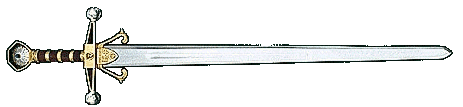
There was a stump at the very end of the fight just before Kanwulf gets slashed in the stomach. Basically, Adrian went over the wrong stump, because we had previously doctored the stump that we were going to use by cutting halfway through it, so the axe would shear through it without any problem. So when you see Kanwulf take the top six inches off that stump with that aluminum-headed axe, that stump had not been pre-cut. That axe actually sheared the top of that stump completely off. So again, these weapons, regardless of whether they're aluminum or not, have a potential danger, especially when they get moving at speed. The second fight when he fights Kanwulf in the circle of fire, the script chose the claymore, as far as I can tell, simply because it was sort of like tying up loose ends. That this is what I fought Kanwulf with when I didn't know who and what Kanwulf was, and now that I do know who and what Kanwulf is, I have to use the claymore again to sort of bring the whole thing full circle and finally defeat him with the weapon that I failed to defeat him with the first time around. The Highland greatsword, the claidheamh-mòr that Duncan uses, is of course the archetypal Scottish sword. You don't get the single-handed sword, the basket-hilted claidheamh beag until the 18th century. It would have been symbolic of the Scottish clans and the honor of the clan. Of course, it's a much more personal symbol to Duncan, having been his father's sword. The claymore was given to Duncan after the death of his father, when he returned to the village and his father had been killed by raiders, and his mother gave him the claymore, which was of course the symbol of his father's honor and 'the son should have this'.
Clip from "Homeland":
When he was thrown out and his mother says, "You are my son, my bairn!" you know, and did that whole bit. He had many defining moments. You know, just as I said before, there are lots of defining moments. But giving him the claymore... That sealed the fact that he would live as Duncan MacLeod of the Clan MacLeod forever, and not be a ronin, and not be a knight errant. He would always be Duncan MacLeod of the Clan MacLeod. Wherever he would go, he would be the clan leader and have the responsibility of being the clan Leader, no matter who he dealt with or who he lived with. So that sort of sealed his fate and created also a tremendous sense of responsibility, guilt, obligation, within him. Adrian Paul: Duncan MacLeod, I knew better than anybody else, and that's possibly something that I brought. And maybe that's why "Homeland" was so popular, because it had a lot of heart in it, and it was-- I wanted that to be a really special episode.
Clip from "Homeland":
|
|
Bill Panzer (Executive Producer): This idea was kind of floating around. It was, like, in the ether. What would it be like if you sort of topped up on your Quickening and suddenly all of that, all the bad guys that you'd killed kind of bubbled over, and for a period of time you became evil?
I love "Something Wicked". I think that that's when I think Highlander was starting to reach it's pitch of darkness and of madness.
We wanted to deal with what happens with Quickenings. What happens when people take so much of another person's darkness within them, and what happens when they take too much. We found an Indian prototype, which was the heyoka, who takes the evil from the tribe onto himself. And we thought how wonderful this is if we create this character who is a heyoka whose cup runneth over, fills himself up with too much evil, and MacLeod is forced to kill that guy and then becomes evil, and how evil could we make him? This is not something that's usually done on television, where you take your hero and you darken him and then you resurrect him.
We got some comments when we discussed this story with our partners, which we did because we knew it was something that is not usual. Suddenly Adrian Paul, our hero, is a very, very bad dude. They went with it. They said 'No, we've never done this before. No, we've never broadcast anything like this. It's very unusual, but hey, let's try it.'
Clip from "Something Wicked":
He was just dark and he was evil, and he was Jack Nicholson in The Shining -- the face of his -- and that he would kill Richie without thought and he would kill and rape and pillage, and he got filled up.
Clip from "Something Wicked":
Should I just end this cycle of evil right here? But as I say to him, I say 'I followed you. I know who you are and I know what you are. And I know that the Duncan MacLeod that I know is still in there and I'm not willing to give up on him.'
His performance in this was really quite startling. His face and his eyes -- this was one mean son of a bitch, and you want to stay out of his way and you felt it. There are very few people working on television series who could have pulled off what he did.
Clip from "Something Wicked":
Don Paonessa (Producer • Post Production): There are a few things about it that were interesting to me, primarily. The visual effects that we did. The Dark Quickening, which was fun and challenging for me in particular. I had a meeting with Dennis Berry and we decided to, after discussions about what visual events would happen during this Quickening, how to approach it.
We designed a certain way of holding the camera, moving the camera, changing the colors. So {then we told it} to the DP for the lighting so that we could have a kind of moment where we saw visually the Dark Quickening, overcoming and taking over our character.
We decided that what this was going to be was going to be a trip through hell for Duncan MacLeod. What I did with this was I took and did posterization on almost all the shots and created a kind of psychedelic experience that then became what is known as the Dark Quickening. Another thing that was done in the show was that during the course of the story, the more evil that Coltec took in, the more he became evil. The way that we chose to try to portray this was to have these little visual events happen. Coltec would do something, and then he would suddenly become sort of a negative-positive image. And it was just a flash, but it was a way in which we decided that we could convey the idea of something going on with this character.
Clip from "Something Wicked":
The end result was, I thought, a very interesting and unique experience for the viewer. Bill Panzer: Everything that Peter Davis and I learned about swords, we learned on Highlander. And everything we learned on Highlander, we learned from Bob Anderson, who was the most legendary famous sword master in Hollywood and theatrical history. He taught Errol Flynn. He taught the light sword. He was absolutely a genius. And there must have been a special affection for the Highlander legend and the Highlander material in Bob's heart, because it's the only time that he ever did television.
In the episode "Something Wicked", the character of Coltec takes one too many Quickenings and turns evil. In the first fight with MacLeod, MacLeod is reticent to fight him because they're old friends who go back many, many years. So I have MacLeod throw him off the Capilano bridge into the river below using a pommel hook to the back of the neck, which we'll try and do for you now. [Anthony De Longis charges toward F. Braun. They exchange a few sword blows, then F. Braun hooks the pommel of his katana behind De Longis's neck and flings him forward.] Stan Kirsch (Actor): The episode itself was a bit emotionally charged, because at the time I also knew that I wasn't going to be shooting Highlander for the next eight, nine months at least. So I knew that what was happening on camera was also a reflection of what was happening off camera.
Clip from "Something Wicked":
During the fight, Richie is really forced to defend himself. And again, very much an image very like the one that we have just seen with Mac and Coltec, where one person is being forced to defend himself against a person he thought he knew.
Stan, having to confront his best friend MacLeod, his hero, his mentor, and realize that this mentor is going to try to take his head off. And I can tell you Stan was scared.
It was the first time that I sword fought with Adrian. I worked very hard on that fight. In the first rehearsals, he could tell that I had worked a lot with the sword and I was quite... I was quick. I knew what I was doing and I was excited to do it. And I was coming after him.
I had Mac cut Richie, I think four times, and every time he would do it, he's clearly savoring the pain that he was causing. We very rarely, if ever, see MacLeod really enjoy taking a person apart in a fight, especially a person who is, for all intents and purposes, an innocent bystander, let alone a friend. The kiss on the head at the end was completely Adrian's, was so evil at the end. I don't think Richie was expecting it at all either.
And Adrian was acting and acting, acting this violent impulse. And Adrian, who loves Stan in life, had to work himself up into this kind of hate.
It was the first time that we really sort of stayed in character all day. There was a real sense of attack and defend.
And at a point, Stan didn't know if he was, in reality, with an angry MacLeod, or if it was acting, he got a little bit scared, which looked great on camera.
We still didn't talk to each other, until it was all done, all the angles were done. And then we kind of went over and gave each other a hug. And it was one of those moments where you kind of felt like something really, might have really happened when the camera was rolling. We were in that space. We were in that space. And I know that I drove Adrian to really come after me. And it made me feel good that I was able to do that, because I knew he was prepared to sort of take it a bit easy and he didn't. And it was a good time. The original sword constantly broke. And when we did that scene in "Something Wicked", we broke every blade we had.
Behind-the-Scenes clip from "Something Wicked":
I hated that sword. It wasn't a question of 'will it break during the filming of a fight scene'. It's simply WHEN will it break during the filming of a fight scene?
Behind-the-Scenes clip from "Something Wicked":
Richie's sword just sort of blew up like a hand grenade on the set. And we begged the writers, "Please do something to get rid of this sword." So when we did this episode ["End of Innocence", not "Something Wicked"], we decided, "Well, this is the time we are going to break the sword." And the main reason for breaking the sword was just to get rid of it and get a new design in.
People were great in this episode. Joe and Richie and Adrian and Peter, the casting was wonderful. It just played really well. |
|
Bill Panzer: So one of the problems with having somebody who is evil is that you've got to now have him go back to his old self, somewhat changed by the experience, but still now he has to become our hero again, who does good and is good. So we felt that it needed a little bit of magic. It needed something that you had to believe it, but it didn't have to be really grounded in reality, because it was a mystical experience that was going on with him anyway.
There are many core myths built into Highlander, and I think with this one it is redemption and resurrection.
Clip from "Deliverance":
David Abramowitz: I liked Sean Burns a lot, I thought he was a wonderful character. I also think, though, that Immortals die, and in order to make MacLeod truly evil and truly dark, he's got to kill someone who there is weight and there is value and there is a price to pay for these things. And we just didn't want to be cheap about it, and we wanted to be honest about it, and there was a price to pay, and it was Sean Burns who would pay that price.
Having him be confronted with his father's sword and with Methos and a kind of a cleansing.
Clip from "Deliverance":
It's the moment in all kinds of movies where a little boy and the champ says, "Get up off the canvas, get up off the canvas," or a light comes through the stained glass of the church, landing on the good guy, and he gets up and gets religion and wins. For MacLeod, the claymore is as much his religion as anything else, and it was, it is the strength of the clan and the strength of all that went before him that enabled him to defeat his own darker side.
It's the 'Dr. Jekyll, Mr. Hyde'. David Abramowitz was going into the darkest part of his own soul-searching, helped with Bill and the need for Adrian to have a sense that we were renewing the series. That's where we took it to its farthest and most extreme places. Bill Panzer: So we found kind of a strange location in Paris that was not a magical, mystical spring at all, but was, as I recall, it was sort of like at the end of a railroad tunnel someplace, but it had some interesting access to it and it was a place where we could build the pond.
The main difficulty in that set was it's a very enclosed space and you're using an immense sword in a set that is partially stone and partially built out of styrofoam and spray-painted, so you can't touch certain things. When I saw the set diagram, the designer never put the elevations onto his diagrams, so I realized that the set doesn't go flat on the floor from point A to point B to point C around the pillars. It goes to the pillar and then it goes up two feet and then another foot and then another foot. So we had to sort of tweak the choreography to climb the mountain up and down as we went around the pillar. So it was... You get those sorts of surprises every now and then. They're not particularly easy to live with, but it happens. Don Paonessa: The show "Deliverance", I think, was quite a good show, and as far as post-production is concerned, the technical problems that we had with the show were minimal. It was cut together pretty much the way it was scripted. We didn't really do much as far as move things around. We didn't restructure at all, as far as I can recall. But what we did do is I continued the motif of using the negative imagery to depict the evilness. In "Deliverance", that effect became a bit subtler than it was in "Something Wicked", and it was an evolution of an idea, and it worked quite well, I think, in "Deliverance". Roger Bellon: When he fought himself and came out of that spring, the music was particularly orchestral with choir on it. It was very happy with it. The emotion that one wanted to attain was sort of positive. The music had to sort of be heavenly in that nature and I think it achieved that particular emotion for that scene.
In production, they created a kind of fountain effect. What we did in post was we took that material and I had Tom Archer, who was the artist, paint these little phosphorescent-looking pixie dust magical phosphorescent stuff that was spraying all over the place and turning Duncan from the evil, bad man into the wonderful human being that he's always been in the show. Ken Gord (Producer): In my experience, every director is different. Some directors come with shot lists. Some directors are what I call organic, which means they kind of just feel it out as they're going along. I'll give you some examples. Dennis Berry is an organic director. If you asked him the day before to tell you how he was going to shoot a certain scene, he would probably throw the script at you, scream at you for about five minutes. He really has no idea how he was going to do it. When he gets to the floor, he works it with the actors and magically somehow gets some pretty nice stuff.
I do not plan ahead of time specifically what shots I'm going to do because of the fact that I love to give actors creative space where they invent things and they come up with other things, and God knows Adrian does, but the other actors too. They have things in their heads, and we find them on the set, on the spot, and then you can film them. If you plan ahead of time, they become a prisoner of what you've planned. The other thing I believe is that we're doing these like little B-movies. We're not doing them like TV films. There's not a given code: we have to cut here, cut back there, go over the shoulder. It's less codified and conventional as your normal TV series.
Denny Berry did a lovely job in shooting them, even though sometimes I would have liked to have shot HIM, but Denny and I had this great love-hate relationship.
Often we would reinvent to what we would find what was written. We'd sometimes even reinvent a period, I mean, for example, once we were supposed to do a Scottish flashback, but we had a great, great civil war scenery and costumes, and it became civil war. [laughs]
So I have the deepest respect for him even though he drove me crazy at times.
I wanted to do something that would then be cut as an hour and a half film, so that "Something Wicked" and "Deliverance" was planned that way, even sacrificed a few episodes so that I would bounce on my feet, date-wise, to be able to do this, because it was one of my dreams. |
|
Bill Panzer (Executive Producer): The idea that Methos and Amanda -- fairly far apart on the Immortal spectrum -- teaming up to accomplish a common goal, was something that we really had never, had never really done before.
Clip from "Methuselah's Gift":
I think they were polar opposites. Amanda is a thief, self-centered, no harm, no foul. If it doesn't kill you, it might not be bad for you.
Clip from "Methuselah's Gift":
I think Rebecca tried to teach her honor, tried to teach her self-- of self-worth and courage. And I think on some level she was successful. She taught her poise, she taught her courage. Ken Gord (Producer): "Methuselah's Gift" was probably one of the most difficult shows of the six years. It had big stunts. The biggest stunts we ever did, actually, in the opening sequence. It was an extremely expensive stunt and we couldn't really afford to do it. We got Hennessy actually to pay a few bucks and help us out. We built the sign because we had to destroy it. We shot with a crane and, I don't know how many stories that building was -- six or seven stories at least. And it took, we shot it over I think two or three days, which for a television series is really kind of remarkable.
Clip from "Methuselah's Gift":
Adrian was very, very keen on, you know, doing something pretty spectacular there, and we all just, you know, dug in and supported him. So I think it worked out pretty well.
Clip from "Methuselah's Gift":
F. Braun McAsh (Sword Master): We had this train marshalling yard, an indoor set with train after train after train after train.
We didn't know whether we were going to get this location or not, and it was, it was touch and go until the end, and then finally we did.
Essentially what Adrian wanted to do with the fight was film the entire thing in one long traveling shot.
I wanted them to do an entire sword fight off of a train and then do a dialogue scene.
Once you get inside these old steam locomotives, there are all these things that you have to sort of avoid, and the camera can just deke around the front of it, but the actors are sort of having to pick their way through all of this stuff as they go through the locomotive and then jump down and whatnot, because the locomotive itself is like about-- the foot plate is about six feet off the ground. Plus we had a couple of sort of effects shots with one of the swords hitting a fire extinguisher and releasing a lot of CO2 and whatnot. So it was a very difficult thing. It's not usual to be able to film a fight in one continuous shot. First of all, because it's usually not technically feasible for the camera to be able to track that length of time, but mainly because the actors get so little rehearsal that it's very rare that they have the physical ability to do a fight from point A to point Z non-stop, regardless of what sort of physical surroundings they're in.
We got up and down through the trains and I remember Elizabeth, a couple of takes, was just so exhausting. She said, "Adrian, I can't hold the sword up anymore."
Behind-the-Scenes clip from "Methuselah's Gift":
And I think partly that had something to do with the scene afterward, because it's like anything. You have a thought process going on. It stops your impulses, and they were so tired by the end of it that they did the scene and the scene was just so out there and so it just happened. Peter was so good.
Clip from "Methuselah's Gift":
I think that section of that episode is beautifully written. You go there and you are given the words to express it. It was-- it was a tough scene. It was a tough scene for Lizzy to be part of as well, and you know, it comes out of this, this fight, this violence.
Clip from "Methuselah's Gift":
This was not just Methos saving her because he loved her. It was Methos saving her because how can a man who lives forever allow the woman he loves to die if it might be in his power to save her?
Clip from "Methuselah's Gift":
That was a very cathartic scene to act, because again, I mean, Methos is such a wonderful character because he's brave. He's so courageous. He goes to these places that we don't want to acknowledge. He goes to the edge and he looks over into the abyss, and it's not easy, it's not comfortable, but he does it because he can't face the alternative, which is pretending it's not there.
It's the kind of thing where someone is an atheist and an atheist has a child and the child is dying and someone says "pray". You go to church and you pray, because it doesn't matter what you believe, if there's-- because you're not where-- You might not pray for yourself; you would pray for someone else. That's what Methos does in this episode.
Clip from "Methuselah's Gift":
That was a very painful episode to do because it was about loss, for me as an actor. It was about finding things in my own life that are really important and imagining the loss and really going there, not faking it, not doing wide brushstrokes, but being detailed about it, going there and seeing what it looked like. And it's tremendously cathartic afterwards, but that was a tough scene to do. Don Paonessa (Producer • Post Production): Post production's job was to take and create these pieces of crystal that would then become a solid sphere.
Clip from "Methuselah's Gift":
That was simply done by talking with Adrian before he shot the scene to make sure that--
Behind-the-Scenes clip from "Methuselah's Gift":
[voice-over] --we had a lockdown shot, and the hand that was holding these pieces of crystal. When they were fit together, they then morphed into another object, which was the solid crystal ball.
And then we got to blow up this bridge at the end of the thing. That was pretty grand stuff and that was a great deal of fun, and you don't get the-- Blowing up stuff is always kind of cool.
Clip from "Methuselah's Gift":
What I wanted "Methuselah's Gift" to be was like a mystery, it was a thriller. The whole shootout at the bridge was not supposed to happen.
Clip from "Methuselah's Gift":
You know, even when the bad guy turned around and said, "I want your crystal and I want MacLeod out of here now," well, he's figured out that she's brought MacLeod. However he didn't figure out that MacLeod's already got another plan, and I thought, 'well, what could it be?' And I thought, 'oooh, an explosion would be good.'
Behind-the-Scenes clip from "Methuselah's Gift":
And we set that thing alight, that thing went up pretty well, and I was-- One of my favourite shots was watching Methos, MacLeod and Amanda leaving at the end with the fire behind them.
Clip from "Methuselah's Gift":
Shooting long lens and going through the entire sequence was the best way of shooting it to get the most coverage that I could get and be able to cut from one to another and give it some sort of pace within the scene, because it was a very long scene.
Adrian was really really excited, he was really wound up because he had been getting great material, he had been getting a lot of shots, things had been going really well, and it was not easy stuff. There were a lot of staging problems -- you have people on one side of a bridge, people on the other side of a bridge, people in the middle, and the blocking and just the size of the location made it difficult to shoot.
Stuff I wanted to do but I just didn't have enough daylight to do. I shot that entire sequence, including the explosions, including all the shooting AND the tag in one day, and that took a lot of, um, it took a lot of planning because... I still didn't get all the shots that I wanted to get. I had to have a stunt off a bridge [clip of Geiger falling off bridge into river], I had to watch all the crystals fall [clip of pieces of the crystal falling into the river], I had to have the explosion, I had to have the killing, and I was dealing with like five major characters.
He got it all, and I think he got-- Not only did he get the bridge sequence with the explosion and all the action that went with it, but I think we also shot the tag there. Adrian was, you know, right on top of it all. It was a lot of stuff to do and it was done very well. I think that show delivers on all counts, it's got thrills and spills and a really fascinating story and it's a fun show to watch. It's got it all. |
|
Bill Panzer (Executive Producer): Very often, when you're making an action show, an adventure show, a show that deals with mythic beings, you find that you get to taking yourself a little bit seriously. So every once in a while, we would say, well, let's explore some of the funny stuff that must happen if you live as long as most of these guys live.
Clip from "Till Death":
We wanted to do something which was, if you're married, you're really married, and how many years, and what do you do about divorce, and all of those kinds of things, and we didn't want to make it too serious, so we did "Till Death".
Clip from "Till Death":
So if you can imagine being married for twenty years or forty years or fifty years maybe. Then imagine somebody's been married for three hundred years, had all the same problems that we've always have when we're married. And yet they get together with all their friends, who in their case happen to be most of them Immortal, and every hundred years they get together and they have a celebration. And our idea was to bring back as many Immortals from previous episodes [clip from 1796 flashback, pointing out Sean Burns] that we could that would have known these guys in their lifetimes. Well, this turned out to be harder to do on a technical level than we imagined. Everybody's booked, everybody's busy schedules are planned, months, six months, eight months, a year in advance, and some of our people are musicians and their concert tours go on forever. So it wasn't so easy, but we did get a chance to use our favorite dead Immortal, Roger Daltrey. I mean, we loved it. We had a great time shooting it. And Roger, of course, as always, is Roger.
Behind-the-Scenes clip from "Till Death":
It's the first time I worked with Roger Daltrey that I thought was a wonderful, wonderful person to work with, full of ideas, full of energy. And so, so humble and so worried that it's going to be good, that he comes up with all the time, something else.
Clips from "Till Death":
Roger Daltrey was amazing. What happened with Fitz was he was just going to be in an episode for a couple of days as a bit of stunt casting. And then Werner Stocker became incredibly ill. And the only thing to do was in about eighteen or twenty hours, I stayed up all night, and I wrote twenty-four hours, thirty-six hours straight, and wrote the entire episode because Werner was supposed to be in the entire episode and he died. So we gave the part to Fitz.
Clip from "Till Death":
Fitz played the entire episode and I had great fear, of course, because all I knew of Roger Daltrey is this wonderful, this incredible, you know, singer from The Who and band guy, and it never occurred to me that he would be as good and as charming and as wonderful and as elfin as he was, and he just stayed. He was great.
Clip from "Till Death":
Dennis Berry: One of the wonderful things about Highlander is that I don't think I've done comedy before and I discovered that I had a little knack for comedy, you know, you never know.
Clip from "Till Death":
Obviously, if there's not any humor in the writing, there'll never be humor. And between Daltrey and Adrian, there's so much humor anyway that you can just, like, be the witness with the camera of their own humor and get some jokes and get some fun.
Clip from "Till Death":
Generally on an action-adventure show, you don't get to do comedies. They were harder to do. As Edwin Booth, who was an actor, once said, you know, "Dying is easy. Comedy is hard." And I think that's really true.
In comedy, you have to take more extravagant risks, obviously, because not everybody finds the same things funny. So as far as I'm concerned, as an actor and from the actors that I've worked with, there seems to be this unanimous agreement that comedy is a hell of a lot harder to play.
Key thing about it is you mustn't find it funny and you mustn't play it as if it's funny, because it then becomes kind of self-indulgent and it actually excludes the audience. For me, in all the so-called comedy episodes or comedy moments, the key thing is to not think it's funny.
I like the way you shoot comedy where you have to have two people in the shot, not as many close-ups, and it's almost the reaction that creates the joke.
Behind-the-Scenes clip from "Till Death":
And I like to not, kind of like jam in people's faces the jokes or impose on them, but have it happen in front of their eyes in a kind of discrete elegant way, which great directors do.
Behind-the-Scenes clips from "Till Death":
Behind-the-Scenes clip from "Till Death":
F. Braun McAsh: When you are doing comedic sword fights, well, the opening sword fight, for instance. We are not sure whether that sword fight is real for quite a while. This masked man breaks into this woman's bedroom with a sword in his hand, and she grabs up a sword, so it's obvious from the get-go that they're both Immortals, but she tears the mask off his face with her sword, and then they have a fight through the castle, the chateau.
Behind-the-Scenes clip from "Till Death":
Until the very end, where they start tearing each other's clothing off in the fight itself, which was fun to choreograph and more fun to rehearse, but was kind of-- It's good to do a comedic fight every now and then.
Behind-the-Scenes clip from "Till Death":
We ended up in a castle outside of Paris, in the snow, in a snow storm. And we had these clothes that looked very beautiful, a little bit like a little Russian nostalgic moment with these kind of warm, warm fur hats on and everything, and I really enjoyed very much shooting that. F. Braun McAsh: There was this one scene where Madame Valicourt has to rescue Robert from the guillotine, and he's been carted off by the mob because he is a noble, and so she enlists the help of Fitzcairn and MacLeod, and they go riding off to rescue him. And as she's beating on the guards and getting him off onto horseback and spiriting him out, MacLeod and Fitzcairn are riding around, distracting all the soldiers in the crowd. And we had this sort of mob violent scene, as about half a dozen soldiers with sabers and with bayonets on muskets go after MacLeod and Fitzcairn, who are on horseback and slashing away at each other. And of course it was all choreographed -- you'd never allow weapons to be used freeform -- but it wasn't so much that you were on horseback and people are poking up at you with sharp objects that was dangerous. It was the fact that the horses were metal-shod and were on cobblestones. So poor Roger and Adrian are on these horses trying to deal with choreography and slashing to their right and slashing to their left and trying not to cut the horses' ears off or hit the neck of the horse. And meanwhile the horses are just sort of all over the place because they've got metal-shod hooves, and they're on irregular rock surfaces.
Clip from "Till Death":
F. Braun McAsh: In the episode "Till Death", the Valicourts fight through the ballroom of their chateau in the evening as part of their little play-fight prior to lovemaking. And we use a technique in this that we've used on other shows, but this is probably one of the better examples of it, where the choreography allows the actors to pass each other on sword moves so that you get both the actors' faces in shot, first one, then the other, and then the other again, and it allows us to, in some times, film the fight scene a little faster because the camera doesn't have to move to get both of the faces in. And we'll show you a little bit of an example here. F. Braun & De Longis stage a brief fight where they trade positions back and forth in front of the camera.] Peter Wingfield: The key to making fights work is for them to be part of the story, that they aren't just "okay, and here they fight". It's "HOW does this character fight?" And the nice thing about "Till Death" was it was-- you know, Methos is sneaky, he's duplicitous, he's just not fair.
Now that one was kind of fun because it was a completely set-up fight. Methos and Robert are fighting to try and win Madame Valicourt's favor back again by putting Robert in some kind of a danger where she is going to want to rescue him, to sort of rekindle that passion that she once had for him. So what Methos and Robert have done is choreographed a little set fight. In the middle of the phrase, Robert forgets a move and almost nails Methos, and Methos manages to parry the move. They go into what's called a corps-à-corps where both the swords meet and he grabs Robert and pulls him into it.
Clip from "Till Death":
And explains the choreography of the next phrase to him, then shoves him off and they sort of do it again, which was something that wasn't in the script, I just sort of added because it was fun. And at the beginning of the fight, of course, when they're just sort of watching the car come in and just sort of tinking the swords together to create some noise, we added that from scratch too, none of that was in the script. But it was fun, especially at the end when Methos is supposed to just give him a little cut on the ribs, and he decides for dramatic credibility, he will just run him through right to the hilt of the sword. The fellow playing Robert was a very good actor and they milked it for all of its comedic worth. I thought it was quite funny.
Clip from "Till Death":
|
BACK to Transcripts Page
| Home |
| Personal |
Tess |
TV shows |
Lord of the Rings |
Pern |
| Actors |
Buffy |
Highlander |
Transcripts |
Fanfiction Links |
| Check out my Sitemap for more 'updates' info. | Last updated: August 13, 2026 |